Monday, January 15, 2007

Sensible Senses

How many senses does a human have? Many would readily come with an answer, SIX. This was really an interesting question and I went in search if some more could be found. Then I hit with something quite interesting and intriguing too! As usual, Thirumoolar had the answer to this interesting question and I was really amazed at his classification and the visualisation of the senses, which he did thousands of years back. Well, let us not prolong the suspense anymore. Thirumoolar in his masterpiece Thirumandhiram states that humans have 10 senses, yes T...E...N, ten senses. His classification is quite awesome and true indeed, that we would agree that his classification of senses is rather true. Well the song goes like this


"Uttrarivu Aindhum Unarndha Arivu Aaru Yaezhum
Katrarivu Yettum Kalandha Arivu Onbadhum
Patriya Paththum Palavagai Naazhigai
Attradhu Ariyaadhu Azhigindra Vaarae"

meaning, The five senses, Sight, Hearing, Touch, Taste and Smell are the inherent ones. The sixth and the seventh senses are those that are realised - Common sense and the sense that we get out of Experimenting. The eighth sense is the one that we get out of our Experience. The ninth sense is the one that we get out of our Public Relations. And the tenth one being the realisation of the Supreme Being. Getting all these ten senses will take a long time, but normal people perish without realising and acquiring these senses

Uttra - Inherent
Arivu - Sense
Unarndha - Realised
Aaru - Six
Yaezhu - Seven
Katra - Learnt, Experienced
Kalandha - Mixed, Relating
Onbadhu - Nine
Patriya - Grasping the hold (of the Supreme Being)
Paththu - Ten
Palavagai - Lots of types (in this context, lots of amount of time)
Naazhigai - in a general sense, time. Otherwise it refers to a unit of time that is equal to 24 mins. 60 Naazhigai's make one day
Attradhu - Word that refers to the above senses
Ariyaadhu - Without knowing or realising
Azhigindra - Perish, get destroyed
Vaarae - Hence

To think beyond the usual classification of six senses, requires some great thought. Though we might contain the others senses as being a part of common sense. However, the way Thirumoolar perceives is that they are distinct on their own, that those senses deserve to be separate on their own. Lets take the case one by one. We will consider the senses that have been listed after common sense, that is 7 to 10.

Sense got by experimenting, unless you have put your fingers in a candle flame you would not have the sense of how fire is. Or even take the case of an electric shock, you would not have known until you have experimented with those by yourselves.

Sense got by experience, I guess this does not require much of an explanation. Experienced people in any field can do things more or less instinctively than the new ones, so we can classify it as a separate sense. For eg, driving, after a point in time, you do that instinctively as you have more experience in driving and the rest is history.

Sense got by mixing with people, Public relations. In day to day life you need to mix with a lot of people, so you are able to judge people, work with them, etc in your daily routine. So that knowledge serves to be what is know as Public Relations, Customer Relationship, etc.

The tenth sense is a bit complex to explain, rather many people have tried to explain and have not been able to explain it more clearly. It is realising the Supreme Being, God. You cannot explain verbally about it. You have to experience it yourself. In simple terms, all objects that exist in the world are manifestations of the basic form - matter. Their shape and composition varies, but the matter inside it is the same. And so is the Universal Being. Realising God, takes a few more steps that people need to put in their effort. Until then they have not opened that sense.

And as Thirumoolar rightly says, most people perish even before they realise that these senses are there and can be attained. And a man is complete only if he has all these 10 senses. We need to think, how many of these senses we have acquired so far and what we need to do to acquire the others too.

More to come, until then...

Thursday, December 28, 2006

Philosophical Periazhwar!

After quite sometime, a writeup about the great Periazhwar in the month of Margazhi would be more appropriate as it is the season famous for all Vaishnavaites. Periazhwar, also called Vishnu Siddhar, Battarpiraan, Pattanaadan, Srivillipuththooraar, is one of the most revered Azhwars. Azhwar means one who goes deep especially in devotion. And this "Azhwar" adornment is given to the persons in deep devotion to Lord Vishnu. There are 12 such "Azhwars", who devoted their entire life just for the devotion to Lord Vishnu. The Azhwars have sung so many songs, called Paasurams, in praise of Lord Vishnu and those songs are collectively called "Naalayira Dhivya Prabandham" meaning "Four Thousand Divine Relations/Connections(through songs)". Nowadays, devotees who do Godly services in Vishnu Temples are also called Azhwars.

So what is the speciality of Periazhwar, that he is one of the most revered of Azhwars.

  • First, he has sung great songs in praise of Lord Vishnu
  • Second, he found Aandaal, Goddess Lakshmi incarnate, as a child in the garden and brought her up. Aandaal is the only female Azhwar.
  • Third, As a result of giving his daughter Aandaal in marriage to Lord Ranganathar at Srirangam, he became the father-in-law for Lord Vishnu, which no other Azhwar has attained.
  • He was the reason for the practice of submitting yearly accounts of Srirangam temple to Srivillipuththoor temple. This is as if Lord Vishnu showing the expenses to his wife Aandaal and the Srivillipuththoor temple. Even today, it is celebrated as a festival.

Now lets get into his songs. So whats, special about his songs? If you read the other Azhwars' songs, all of them would have sung the songs in praise of the Lord. But Periazhwar goes one step further and bless Lord Vishnu. Here goes his Pasurams.


"Pallaandu Pallaandu Pallaayirathaandu
Palakodi Nooraayiram
Mallaanda ThinnThol Manivanna Unn
Saevadi Sevvi Thirukkaapu"

meaning, Long live Lord Vishnu for many crores and hundreds of thousands of years. And the Lotus feet shine and be protected for the above mentioned years of the great person with mighty and powerful shoulders.

Pallaandu - Many years
Pallayiram - Many thousands
Aandu - Years
Palakodi - Many Crores
Nooraayiram - 100,000
Mallaanda - Wrestling
ThinnThol - Strong and might shoulders
Manivanna - another name of Lord Vishnu
Saevadi - Lotus Feet
Sevvi - Shine, being red in colour
Thiru - Divine
Kaapu - Protection


"Adiyodum Ninnodum Pirivindri
Aayiram Pallaandu
Vadivaai Ninnvala Maarbinil Vaazhkindra
Mangayum Pallaandu
Vadivaar Jodhi Valaththuraiyum
Sudaraazhiyum Pallaandu
Padaipore Pukku Muzhangum
Appaancha Channiyamum Pallaandae"

meaning, Let me stay at Your Lotus feet, with You and without separation for Thousands of years. Thousands of years to Goddess Lakshmi who resides in right side of your chest. Thousands of years to the Sudharshana Chakra (Sakkarathaazhwar) who resides on Your right shoulder. Thousands of years to the Panchachanniyam (Conch), that sounds when You go into battles.

The above songs are a proof of why Periazhwar is venerated so much. No other azhwar has attempted or even thought of blessing The Lord himself. By doing so he positions himself as a parent, which apparently he became after giving his daughter in marriage to the Lord. There are 12 such blessings Paasurams. These Paasurams are being sung as a hymn in all Vaishnavaite temples during the Vaigunda Yaegaadhasi, Bramhothsavam and other auspicious events.

Another masterpiece of Periazhwar are the Paasurams that is believed to cure any disease when sung regularly.


"Neikudathai Patri Yaerum Yerumbugal
Pol Nirandhu Yengum
Kaikondu Nirkindra Noigaal
Kaalam Pera Uyiaa Pomin
Meikondu Vandhu Pugundhu
Vedha Piraanaar Kidandhaar
Paikkonda Paambanai Yodum
Pandandru Pattinam Kaapae"

meaning, To all the diseases that crowd my body as the ants (as a colony) that climb and cover the ghee pot and be spread all over it. If you want to survive, get out of my body immediately. The Lord of the Vedhas has entered my body bringing with Him the Truth and is residing in my body. The Lord inhabiting my body with his snake bed, makes my body like a fortified city. So all diseases get out of my body.

This way, he warns, intimidates and even pleads the disease to leave the body. People believe and have even said that they got their diseases cured on chanting the Paasurams.

Periazhwar, as his name suggests, is a great man who has won the heart of the God himself, by his devotion and his Paasurams and of course bringing up a child who also became an Azhwar. That is simply a great achievement. His works will live Pallaandu till time and space exist.

More to come, until then...

Sunday, December 03, 2006

Awe-Inspiring Darasuram

Darasuram - an exquisite place that takes you back in time to enjoy all the beauty and richness of art. I was fortunate that I went to the temple to be awe-inspired by the creative beauty and the hardwork that was put up by our ancestors. The Airawadheswarar (Lord Shiva) temple was built during the 11th Century by King Rajendra Cholan, son of King RajaRaja - The Great! Airawadham means the elephant that Lord Indra has. The temple is full of great sculptures that you lose yourself in the beauty and the delicate artwork. The sculptures are so fine and minute that you can even feel the hair in the tail of a bull that is in the size of the match box sculpted in one of the 108 pillars in the main mandapam (hall). The temple is built with that concept that it is on top of an open Lotus flower, and if it rains in that place, rain water stays and gives an appearance that the temple is floating on the lotus flower. Another interesting thing about this temple is that when the temple has been built in such a way that there always a flow of water in the moat at the entrance of the temple, so that anyone entering the temple would wash their feet and go in clean. However, there is no water nowadays in the moat. The temple is maintained by the Archaelogical Society of India (ASI) and is declared as a heritage site by the UNESCO. Enjoy some pictures of the great temple.


Gopuram at Darasuram - Entrance to the Great Temple


Gopuram - Another view


Gopuram - Another view


Nandhi in front of the Gopuram
Behind the Nandhi is a staircase (that is now covered and protected) and is made of rock that each step will sound each of the seven swaras in order.


The outer wall of the temple and its Gopuram- now in desolate ruins


The view of the temple main mandapam
Designed as a chariot being pulled by horses
This mandapam host 108 pillars in which different epics and legends are carved to their minute details. An exquisite and a awesome work by the sculptor.


The Vimanam (tower) of the temple. An awesome piece of work!


A pillar in the main mandapam, carved out a single stone!


The front view of one of the pillars. Five animals combined into one
(Elephant -Trunk, Goat - Horn, Horse - Ears, Lion - Boday, Tiger - Legs and Paws)


Another view of the Airawadheshwarar temple vimanam


Dheiva Nayaki Amman Temple
(Temple beside the Airawadeshwarar Temple)


Dheiva Nayaki Amman Temple - Another view
(Temple beside the Airawadeshwarar Temple)


Dheiva Nayaki Amman Temple - Front View
(Temple beside the Airawadeshwarar Temple)


A sculpture at Airawadeshwarar Temple, that is a gestalt of dancing ladies. Just look into the red box, you could see three dancers with one head. You have to cover the other two to see one lady in a dancing pose. The artist's imagination is simply out of this world


The images of the 63 Nayanmars carved out in a stretch


Airawadeshwarar Temple - View from North East


Airawadeshwarar Temple and its main mandapam- View from North East

Airawadeshwarar Temple and its main mandapam- Another View from North East (In the picture - Vijayendran and Pradeep)

It is not just the stones here that fascinate, but the hardwork and the masterminds that made this happen. And of course, the grace of God (Lord Shiva) to have a temple built for Him . We should be really proud of our ancestors and ourselves. More high resolution pictures here. The temple is just 3 kms from Kumbakonam, a place near Tiruchirapalli (Trichy).

More to come, until then...

Sunday, November 12, 2006

Importance of a Guru (Teacher)

We all know the four important beings that shape our life, Maatha, Pitha, Guru and Dheivam that is Mother, Father, Teacher and God. The teacher plays an important role in shaping up who we are. But most of us neglect such great beings that helped us to grow what we are now. Teacher, being the eliminator of our oblivion and darkness in our mind, showers light and knowledge; and shows us the world. So what is his importance and what would happen if one misses a good teacher in his life. Luckily by God's grace I got one good teacher whom I consider my Guru. He is Mr. B. Anandakumar, who taught me Mathematics when I was doing my High School. For without him I would not have been the one I am now. I owe him lots of gratitude. Well, lets not get into my personal history. We will get back to what happens if one does not have a good teacher in his life. As usual let's resort to Tamil Literature! Thirumoolar gives an excellent explanation for the importance of a guru and the answer to our question. The song goes like this


"Kuruttinai Neekkum Guruvinai Kollaar
Kuruttinai Neekkaa Guruvinai Kolvaar

Kurudum Kurudum Kurudaatam Aadi

Kurudum Kurudum Kuzhi Vizhumaarae"

- Thirumoolar


meaning, The ones who don't have a Guru who can eliminate their ignorance are blind. The ones who have a person as a Guru, who is not capable of removing the ignorance of their minds, are blind. Both these blind people live their life as the real blind people play a blindfolded game. Both these blind persons, fall into a quagmire where they cannot be recovered, as would the real blind people who would fall into a deep pit.

Kurudu - Blindness, Ignorance

Neekkum - Remove, Eliminate
Guru - Teacher

Kollaar - People not having something

Neekkaa - Negation of Neekkum

Kurudaatam - Blindfolded game

Aadi - play

Kuzhi - Pit
Vizhum - Fall


As Thirumoolar explains, without a Guru, we would not be able to get across the ocean of ignorance. So how do we need to treat such a noble person. This song also states that a Guru has to have qualities of removing a person's ignorance. So we should hold such a person in great respects in our hearts. There is a legend from the Ramayana that states how one should respect a Guru.


Lord Rama defeated Ravana and Ravana was in his deathbed breathing the last few breaths of his life. At that time Lakshmana felt happy that a cruel and bad person was defeated atlast. Then Lord Rama told Lakshmana, "Don't underestimate or consider Ravana badly. He is a great person. A learned man, a great ruler and a great warrior. He knows what is just and what is unjust. The greatness of such a person went down just because he was uxorious. Other than that there is no learned man as Ravana is"

Lakshmana got a bit surprised when his brother had a very good respect in his heart for Ravana. In fact, there are only two persons who are adorned with the sacred name Eashwaran (Lord Shiva). One is Saneeshwaran (Saturn, for his unbiased testing of human endurance and truth) and the other Elangeshwaran (King of Lanka - Ravana). So this itself shows how great should Ravana have been to attain such an adornment to his name.

Lord Rama, now told Lakshmana, "If you still have doubts about Ravana's learnedness, go ask him about the protocol to wage a war?"

In those days, there was a protocol to wage a war. The war would be waged in a separate area of the country normally the boundaries, without disturbing the civil life and only the people in the army would fight. The civilians will be unharmed. Also prior information would be given to the parties involved in the war.


So Lakshmana honouring his brother's order, went straight to Ravana who was in his deathbed and stood near his head and told, "My brother told me to ask you about the protocol to wage a war"


Ravana calmy replied, "Haven't your learned in your Gurukulam about how you should ask a question to a Guru?"


Lakshman was confused when Ravana asked this question. Ravana continued, "You have asked me a question and am going to answer it. So I am in the position of a Guru and you are in the position of a student. So, now stand near my feet and ask your question"


Lakshmana was shocked at this reply, he felt bad that he forgot the basic qualities of a good student. And Ravana's reply really pricked his conscience. He went to Ravana's feet and got the answer from him. Then he realised that what Lord Rama said was absolutely true.


So this legend is an example of how a Guru should be given respect. But, nowadays...! Even, if we don't follow such protocols, we can at least have it at heart. So we shall put a thought about it and remember our Gurus, the ladders of our life. As a final note,


IF YOU CAN READ THIS, THANK A TEACHER!

More to come, until then...

Wednesday, November 08, 2006

Exquisite Chithira Thaer

One of the most fascinating and exquisite works in Tamil Literature, that I had been searching for long and found in my recent trip to Kumbakonam is the Chithira Thaer, meaning Artistic Car/Chariot. The literary eloquence really is awe-inspiring and is in a different dimension, that I have not seen/heard such a work in any other language. I found the Chithira Thaer at two places in Kumbakonam, one at the Saarangapani Temple (in praise of Lord Rama) and the other at the Kumbeshwarar Temple (in praise of Lord Shiva). The Chithira Thaer at Saarangapani Temple is a work by Thirumangai Azhwar, and this form of poetry is called the Thiru Ezhu Kootru Arikkai. The Chithira Thaer at Kumbeshwarar Temple is by Thiru Gnana Sambandhar.


The Chithira Thaer consists of many boxes in the form of a Chariot and each box containing a short verse. The speciality is that you can read the contents from the boxes from any line but in order, will give you a meaningful verse. For e.g. take the content from box 1 in line 1 and then box 2 in line 3 and then box 3 in line 2 and so on - will give you a complete meaning. So the order of reading should be of the form.

1,2,...n,...,2,1

Only the numbers need to be in that order, the content can be from any row. It is such a literary beauty that has to be treasured and to be felt proud of.

Take a look at the wonderful masterpiece.


Chithira Thaer at The Saarangapani Temple, Kumbakonam

A high resolution picture is available here

More to come, until then...

Sunday, October 15, 2006

Solving Sorrows - Part 2

Laughing away the sorrows is not an easy task and everyone cannot take it that way because most are quite bound by their emotions that a verbal statement will not bring an effect immediately. It requires some practice and the mind needs to get trained to treat sorrows and joys equally. It requires a more composed state of mind to see those two as delusions in life rather than life itself. So what does Tamil literature has to offer for these people. Yes indeed it does have another way, though not a way for the atheists. Well, to summarise what it is - think every event, joyous or sad, to be an act of God, submit yourself to God continue with your work and that will save yourself from worries. A song by Avaiyar illustrates this point


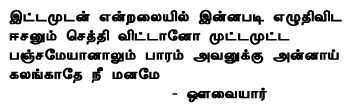
"Ittamudan (Ishtamudan) Enn Thalayil Innapadi Ezhuthivida
Easanum Seththi Vittaano MuttaMutta

Panjamae Aanaalum Baaram Avanukku Annaai

Kalangaadhae Nee Manamae"


-- Avaiyar

meaning, Did Lord Shiva willingly determine to write the fate on my head that I should suffer, and He wrote so? Even if I suffer and fail in all my attempts in life, it is the burden of the God (Lord Shiva) I believe to relieve me out of the troubles. So don't worry my heart.


Ittamudan (Ishtamudan) - Willingly
Enn - My

Thalaiyil - in the head (Thalai: head)

Innapadi - Being so according to the context
Ezhuthivida - Determined to write (Ezhudhu - Write)
Easanum - Lord Shiva
Seththi - Consider, thinking

Vittaano - Wrote
Mutta Mutta - expression used to indicate repetitive attempts

Panajam - Failure, Misery

Aanaalum - Happen to be so
Baaram - Burden

Avanukku - For Him (Lord Shiva in this context)
Annaai - A state of activity

Kalangaadhae - Don't Worry

Nee - You
Manamae - Heart, Mind


So as the song explains, leave all your troubles to God and carry on with your work. Troubles would not hurt you much. There is yet another belief that still solves troubles better. That is, the thought that troubles are an act of God to test us. If you endure those toughness in life, you will shine as gold. Troubles and sorrows are rather things that shape us and brings out of us rare talents within, that makes who we are. There is short story that speakers in some Upanyasam used to tell the gathering. Though the story might sound fictional, it has great meaning in it.


One day a man went to the temple and talked to the God statue. He told that he is facing a lot of troubles and worries in his life. There does not even seem to be any benefit to him in worshipping the God either. So he wanted an answer for it and needs a solution to his problems and live a peaceful life.

The God statue replied, "Long before I was carved into a statue and people started worshipping me, I was a solid rock lying in the mountains. There was no one to help me or heed to my troubles. I was under the hot sun, pouring rains and the cold winters. Later, a sculptor found me and carved me into a statue. Had I not tolerated the baking Sun, the lashing rains, the chilly winters and apart from those, the hammer and the chisel of the sculptor; I would not have been worshipped now by many who come to this temple. So troubles in life are to shape what you are. Facing and tolerating them takes you to a new dimension you never expected."


Now satisfied with answer that the God Statue gave, the man got encouraged and started to live his life bravely.


To even illustrate this concept, there is a song written by the greatest poet of recent times. Rather the king of poets in the 20th century, Kavi Arasu Kannadhasan (Kavi Arasu means King of Poets). The song goes like this


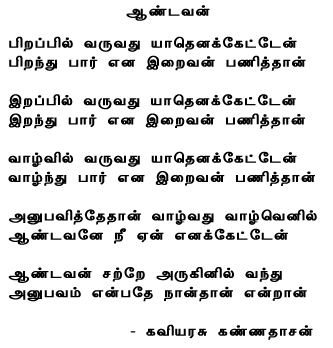
"Pirappil Varuvadhu Yaadhena Kaetaen

Pirandhu Paar Yena Iraivan Panithaan

Irappil Varuvadhu Yaadhena Kaetaen

Irandhu Paar Yena Iraivan Panithaan


Vaazhvil Varuvadhu Yaadhena Kaetaen

Vaazhndhu Paar Yena Iraivan Panithaan


Anubavithae Thaan Vaazhvadhu Vaazhvenil

Aandavanae Nee Yaen Yena Kaetaen

Aandavan Sattrae Aruginil Vandhu

Anubavam Enbathae Naanthaan Endran"

-- Kavi Arasu Kannadhasan


meaning,

I asked God, what do we realise in being born; God instructed me to be born.
I asked God, what do we realise in dying; God instructed me to die.

I asked God, what do we realise in living; God instructed me to live.

I asked God, if experiencing everything is what life is all about, then why are you here.

God came a little bit closer and said, Experience is none other than me!

Pirappil - Birth
Varuvadhu - Derive, realise, come

Yaadhena - What

Kaetaen - Ask

Pirandhu - Be born

Paar - See

Yena - So

Iraivan - God

Panithaan - Instructed

Irappil - Death
Irandhu - Die

Vaazhvil - Life

Vaazhndhu - Live

Anubavithae Thaan - Experiencing

Vaazhvadhu - Living

Vaazhvenil - Life

Aandavan - God

Nee - You

Yaen - Why

Sattrae - A little bit
Aruginil - Close
Vandhu - Came

Anubavam - Experience

Enbathae - is what

Naanthaan - Me

Endran - Act of Person Saying something


A great concept, in simple words! You just consider that all the experiences in life are not only act of God but God himself. The shifting of burden from ourselves to God, gives us the real strength to fight all the tussles and tribulations in life. Although atheists may question the existence of God, they might not feel the benefit they derive out of the invisible means of support. So Tamil literature offers numerous ways to solve troubles and sorrows. It is up for the peoples' mind to choose what they can and what they need. But enduring the troubles makes us what we are and takes us to a new unimaginable dimension.

More to come, until then...


Sunday, October 08, 2006

Solving Sorrows - Part 1

Tamil Literature does not only have in abundance, great songs with indepth meaning but also songs about way of life. Songs that would guide people through the various trials and tribulations of life. Most people get vexed, depressed, disoriented due to the problems and the sorrows they face. Of course, those are parts and parcels of human life, but succumbing to these is not the point of living the life. Tamil literature has umpteen number of songs that guide people on how to deal with the sorrows and troubles they face. How to come out of it and how to attain a peaceful and sucessful life. Many of us have faced and are facing difficulties in our life each tuned for our own dimension. But how we have handled them makes what we are. So what is the solution to all our sorrows and how to handle and live our life. Lets look at a song goes like this


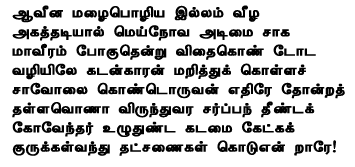
"Aaaveena Mazhai Pozhiya Illam Veezha
Agathadiyaal Mei Nova Adimai Saaga

Maaveeram Pogudhu Endru Vidhai Kondoda

Vazhiyilae Kadankaaran Mariththukkolla
Saavolai Kondoruvan Yedhirae Thondra

Thallavonna Virundhuvara Sarpam Theenda
Kovendhar Uzhudhunda Kadamai Ketka

Gurukkal Vandhu Datchinagal Kodu Yendrarae"


The song illustrates a sequence of events that happen to a man in those days. Lets the see the meaning. "The man had a cow which gave birth to a calf; At that time rains poured like anything making things worse. And even worse his house got destroyed by the rain. At that time, his wife got sick; His servant died. And later the wetness in the land had was drying up, so ran with the seeds to sow for cultivation; On the way, a creditor - person who gave him a loan - caught hold of him. At that time, a messenger brought him a death message. Following that, there came unavoidable guests. And he was bitten by a snake. Then the officials from the king came asking for the tax money. Finally, among all these situations, the Gurukkal - priest of the temple - came asking for donations."

Aaa - Cow, King, God (in this context, Cow)
Eena - produce offspring

Mazhai - Rain; Pozhiya - Pouring
Illam - home, house; Veezha - Fall, destroy

Agathadiyaal - Wife (Agam: Home, Adiyaal: female companion) Mei - Body;
Nova - Pain, suffer

Adimai - Servant; Saaga - dies
Maa - Land; Eeram - Wetness
Pogudhu - Going; Endru - like

Vidhai - seeds; Kondoda - Kondu (take, have) + Oda (run)

Vazhi - Way, Path;
Kadankaaran - Person who gave the loan; Mariththu Kolla - block, stop

Saavu - Death; Olai - Message; Kondoruvan - Kondu + Oruvan (a man)

Yedhirae - Against; Thondra - Appear;

Thallavona - Unavoidable; Virundhu - Guests; Vara - come;

Sarpam - Snake; Theenda - Bite, do harm;

Kovendhar - King;
Uzhudhunda - Uzhudhu (Cultivate) + Unda (derive benefit, Eat);

Kadamai - Duty, Tax; Ketka - Ask;

Gurukkal - Priest of the temple; Vandhu - come;
Datchinaigal - donations;
Kodu - give;
Yendrarae - a person saying something, in this context asking donations
.

Now when you read the meaning of the poem, most of you would have had a gentle smile. It does not mean a sadist expression of laughing at the man in trouble. But all that you can do if you were in that situation would be to smile. That, is the solution to handle and tackle the troubles and sorrows in life. Take things in life with a smile, no matter how difficult it is and don't get dejected or depressed. This is what Thiruvalluvar says in his Kural.


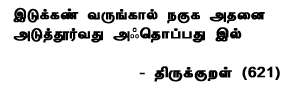
"Idukkan Varungaal Naguga Adhanai

Aduthoorvadhu Agudhu Oppadhill"
- Thiruvalluvar Thirukkural


meaning, "Laugh your trouble/sorrow away. There is no other way to conquer woes."

Idukkan - Sorrow, trouble

Varungaal - Varum (Come) + Kaal (Suppose)
Naguga - Smile, Laugh
Adhanai - a pronoun referring a thing, here, trouble

Aduthoorvadhu - Aduthu (Next, Other) + Thoorvadhu (conquer)

Agudhu - Like, similar
Oppadhil + Oppadhu (Comparing, Matching) + Ill - (Not existing)


So why to worry, when you can laugh your sorrows away. Great people have realised this truth and gave it to us, which we should pass it on to the generations to come. Take life as it happens, what is destined to happen will happen. Prepare for the worst; expect the best; take what comes.

More to come, until then...