Wednesday, May 17, 2006

An unsolved conundrum about a bullion!!

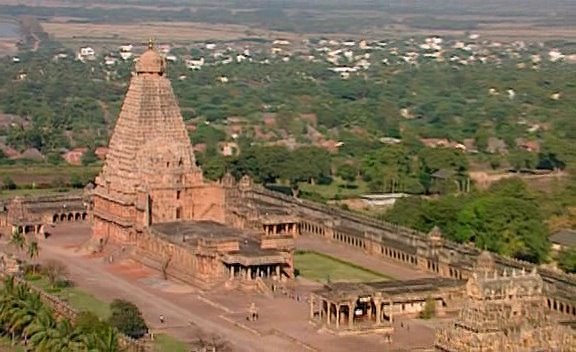
The world would have been aware of the famous bullion mystery Yamashita's Gold and many Filipinos are digging even today to search it. But there is one in Tamil Nadu. In a place called Marungapallam, within the Peravurani jurisdiction of Thanjavur District (Thanjavur, also called Tanjore - The place of the great Brahadeeshwara temple). The inscriptions on the rock carvings in the temple of Lord Shiva at Marungapallam has one similar unsolved conundrum about a bullion. The puzzle is unsolved to this day. It has a story behind it, but first the inscription in the form of a song. It goes like this,
"Ezhuvaanukkum Thozuvaanukkum Edaiyilay
Kaakai Mookin Nizhalilay
Kalvar Pogum Vazhiyilay
Kandaalum Kammaalan Kannilay
Ezhubadhu Kodi Pasumpon"
- Inscription at Lord Shiva Temple
in Marungapallam

meaning -

"Between the one who rises and the one who worships,
In the shadow of a crow's beak,
In the path used by thieves,
Even if seen only recognisable by the goldsmith,
There is Seventy Crores pure gold"

The interlingual rendition is as follows,
Ezhuvaan - The person who rises, probably the Sun
Thozhuvaan - The person who worships, probably the human
Edaiyilay - in between
Kaakai - Crow
Mookin - possessive case of Mooku - beak, nose
Nizhalilay - possessive case of Nizhalal - shadow
Kalvar - Plural of Kalvan - Thief
Pogum - Going
Vazhi - Path or route
Kandalum - Seeing, in this case, even if seen
Kammaalan - Goldsmith
Kannil - in the Eyes (Kann)
Ezhubadhu - Seventy
Kodi - Crore
Pasumpon - Pasumai (fertile, pure, rich) + Pon (Gold)

Well, now the story behind it. There once lived a goldsmith who had somehow acquired a huge bullion of gold. He kept that information as a secret and he began the purifying process of the gold. So while purifying the gold, he collected the wastes which were like impure iron and threw it away as it had no use or value. This aroused suspicion among the spies of the then king of the region and the secret was delivered to the king and the king ordered his men to get that gold. The goldsmith on knowing that the secret is not a secret anymore, hastily went to hide the gold. And he hid that bullion in some place and to safeguard that place, he sacrificed his own daughter to the Gods (a cruel practice that was believed in those days), called Kaavu Koduthal in Tamil meaning sacrificing life for some purpose, and wrote the above song in an inscription and committed suicide. The waste product that the goldsmith dumped was collected by people and used as a cure to Anaemia. It was named as Nagur Raththa Sogai Marundhu (Nagur - a place in Tamil Nadu near Thanjavur; Raththa (Blood) Sogai (non-vitality) - Anaemia; Marundhu - Medicine). And it is said that people actual got cured of anaemia. Whatsoever be it, the place where he hid that gold is still a mystery to this day as Yamashita's Gold

More to come, until then...

Friday, May 05, 2006

The Glorious Garuda

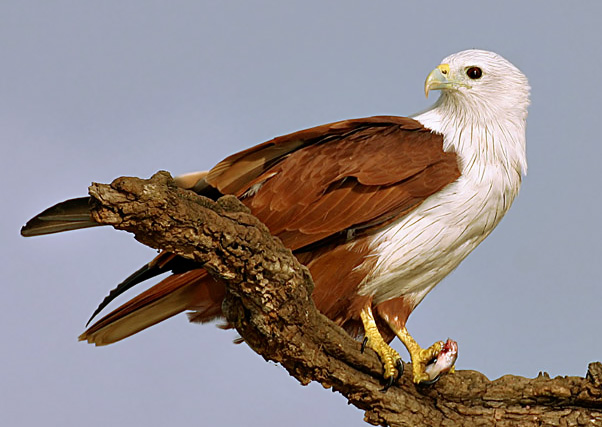
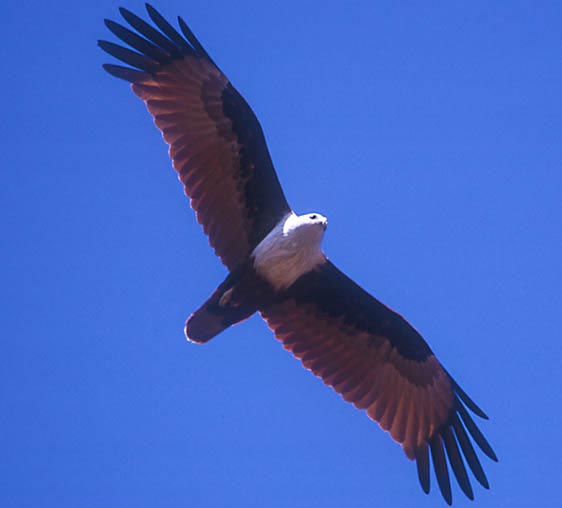
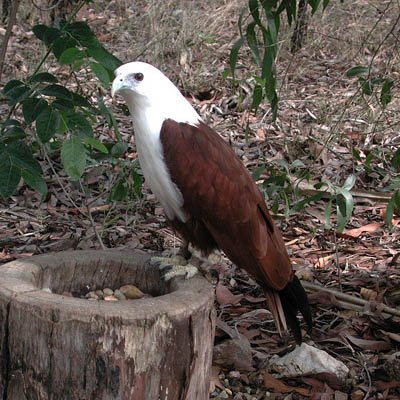
Garuda - The Brahmini Kite - is one of the most revered birds in India. It is the mount/vechicle of Lord Vishnu. It is also called the Krishnar Parundu/Kazhugu meaning the Kite/Eagle of Lord Krishna. The Garuda is so sacred that is worshipped as a deity named Garudaazhwar in many Vishnu temples. It is even a strange phenomenon that it circles the temple in which auspicious events like the Kumbabishekam and other yearly festivals are being conducted. Garuda is believed to have strange powers that even its shadow would act as an antidote to the poison of a snake and alleviate the effects of the venom. I am not sure about the truth of the statement, but the belief exists. There is even a sacred text, in Sanskrit, called The Garuda Puranam in its name. Tamil to has its part about Garuda. And seeing a Garudan is a good Sagunam (omen), a Tamil song goes like this


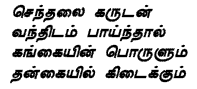
Senthalai Garudan
Vandhidam Paainthaal

Gangayin Porulum
Thann Kayil Kidaikkum

- Anonymous


Let me do the interlingual rendition in a bit, first the meaning. It means that if the vivid headed garudan crosses to your left when you start any important event. It indicates a good sagunam that you will get the rare and sacred items of the river Ganga in your hands. The river Ganges is said to be originating from the head of Lord Shiva and so it is so sacred that it cleanses all the sins of the humans. So things got from the Ganga is considered rare and sacred. And obtaining things from the Ganges is not so easy in those days. So if a Garudan flies past to your left, then it indicates a good sagunam. Now the rendition

Senthalai - Red headed, vivid headed (in this context)
Vandhidam = Vandhu (Come) + Idam (Left) - Comes to your left
Paainthal - dive, pounce
Gangayin - Of Ganga (River Ganges)
Porul - Items, Substances
Thann - One's Own
Kayil - In hand(Kai)
Kidaikkum - Will be gotten


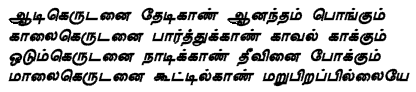
Aadi Garudanai Thedi Kaan Anandham Pongum
Kaalai Garudanai Paarthu Kaan Kaaval Kaakkum
Odum Garudanai Naadi Kaan Theevinai Pokkum
Maalai Garudanai Kootil Kaan Marupirappillaiyae
- Anonymous


meaning, search and find the Garudan in the month of Aadi and you will find joy filling your life. Wait in expectation of the arrival of the Garuda in the morning and see it, it will be a sentinel in your life. Seek the elusive Garudan and envision it, it will destroy all your sins. See the Garudan accompanied by Lord Vishnu in the evening, you will cross the ocean of birth, attain salvation and will never be reborn to meet with all the suffering of birth.

Aadi - Dance; Tamil Month of Aadi (Falls between July and August), auspicious month for the Gods.
(Temples would be crowed during this month and it is not easy to worship the deities in the temple. So you would have to search amongst the crowd to find the deities. Garuda being one of the deities, should be searched and worshipped)

Thedi - Search
Kaan - See
Anandham - Joy, Merry
Pongum - Overflow
Kaalai - Morning
Paarthu - verb. See; adjective. carefully; In this context Edhirpaarthu meaning in expectation
Kaaval - Watch, Sentinel
Kaakum - Protect
Odum - Running
Naadi - Seek
Theevinai - Sins, actions causing sins
Pokkum - Remove, eliminate
Maalai - Evening
Kootil - In the nest (Koodu); accompanied by someone or something
Marupirappillayae = Maru (Again) + Pirappu (Birth) + Illaiyae (No, Negation) - No rebirth

Not only the Garudan, but other birds and animals are venerated and associated with the gods in India. For example, the Snake (Lord Shiva), the mouse and the elephant (Lord Ganesha), the rooster (Lord Muruga), Lord Hanuman (the monkey God), the cow (The Kamadhenu), the bull (Rishaba Devar - mount of Lord Shiva), the buffalo (mount of Yama), the tiger and the lion and so on and so forth. Even the dog is worshipped as the mount of Lord Bairava and even a scorpion has its place. The list goes on. The idea of venerating animals is not to start off any superstition among the people, but it has spiritual, biological and jurisprudential reasons. The spiritual being to the envision the Supreme being as the manifestation of all life forms, the biological being to conserve the ecology and those beings should be in existence, the jurisprudential being, that every animal has its right to existence. I am not starting off any potential argument, but just elucidating the essence of such beliefs.

Apart from the Garuda, one more bird is known to indicate sagunam. It is the Sembothu or the Senbaga, I don't know the exact English name for the bird. But it would be in the size of a cuckoo and has a vibrant orangish brown colour in it body. The song that indicates is


Bothidam Paainthal Maelthadam Vaiyaadhae
- Anonymous


meaning, if the Sembothu flies past to your left, don't dare to step one more foot. Rather it indicates a bad or an unsuccessful sagunam. To be more precise of the meaning, the belief is that if the Sembothu passes to your left while you are about to venture out something, it will not materialise whatever the effort you put.

Bothidam - Bothu (Sembothu) + Idam (Left) - Sembothu going to your left
Paainthaal - dive, pounce
Maelthadam - Mael (Top, Above, More) + Thadam (Path, Tread, footprint) - Treading foot on the path
Vaiyaadhae - Vai means Keep, Vaiyaadhae - negation of Vai

People associate birds and animals to predict the happenings, these beliefs can neither totally be believed nor can be disregarded as superstition. But we have to accept that every life has to be respected and they all have the right to coexist and we cannot hunt them or their habitat leading to their extinction. Maybe, our forefathers thought that at least these spiritual association with the birds and animals could bring about some ecological balance.

Some fascinating pictures of the Garuda...


The majestic Garuda - Brahmini Kite

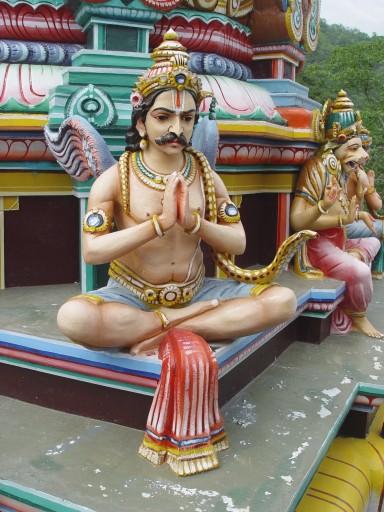
Sculpture of Garuda on a temple's gopuram

Front view of Garuda

Garuda in flight


Side view of the Garuda

More interesting things to come, until then...

Sunday, April 30, 2006

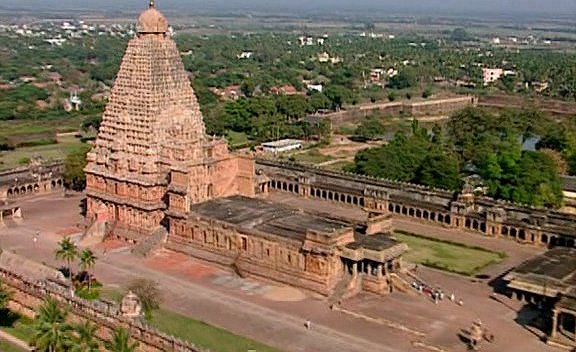
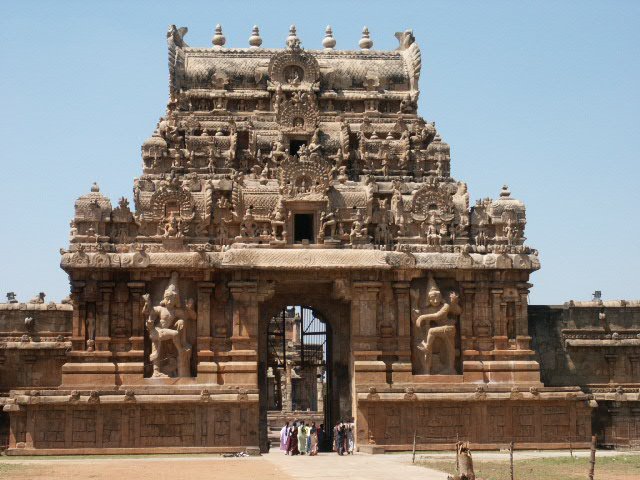
King RajaRaja Cholan and his magnificent splendour

Some magnificent pictures of the great King and his work!!!


King RajaRaja Cholan


Spectacular view of King RajaRaja Cholan's magnificence


Another spectacular view of the temple


Entrance to the temple - The Gopuram

More to come, until then...
Tuesday, April 18, 2006

The Hidden Treasures in Tamil!!!

"To read between the lines" is a famous phrase used in English literature to infer something different from what is plainly indicated or to detect the real meaning as distinguished from the apparent meaning. Tamil has a wealth of such songs, information written by various poets saints etc., which I refer to as hidden treasures. These treasures have to be unearthed meticulously to get the great meaning inside them. Now lets jump into the treasure hunt. From this post onwards, I will try to post the text in Tamil too, to help the Tamil readers. The transliteration in English will continue as before. Well, now on to the first one,

"Kaanamal Konaamal Kandu Kodu
Aadu Kaana Pogudhu Paar Pogudhu Paar"
- Edaikaadar


On the first look, the meaning looks as if it means something with charity. We could derive plainly like this

Kaanamal - Without seeing
Konaamal - Without deviating, Without showing any grimace
Kandu - Seeing, Address
Kodu - Give
Aadu - Goat, Dance, Bathe
Kaana - On seeing
Pogudhu - Goes away
Paar - See

So clubbing it together, it might seem to be Without seeing the differences, Without deviating or showing grimace, address the needs of the poor and give them what you have and dance in merry then you will see your worries go away, go away

Nice try!!! However the actual meaning is not it. It is a song that relates to the way to worshipping the Sun at different times during the day. History tells that Sun has been worshipped as a God in many civilisations and being worshipped even to this day. Many slogams in Sanskrit especially the Aaditya Hridhayam is in praise of the Sun God. Well let's get back to the song, it means

"At dawn, the sun should be worshipped without seeing (Kaanamal), that is before He rises.
In the noon, without deviating (Konaamal), that is when He is right above your head.
And in the evening, seeing (Kandu), that is during sunset.
Then give (Kodu) your offerings.
Then Bathe (Aadu).
Then Realise and see the God in yourself (Kaana).
Then you can see your sins going way (Pogudhu Paar Pogudhu Paar)"

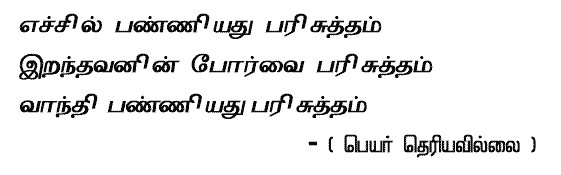
The next one might sound rather unacceptable in then normal case, but it is not actually, it conveys a greater meaning inside. Let's look at it now, it states three things that considered as purity or rather purest of the pure (Parisutham).


"Yechil Panniyadhu Parisutham
Erandhavanin Poravai Parisutham

Vaandhi Panniyadhu Parisutham"
- Anonymous


Paraphrasing the above song, would mean the following,

  • Yechil (Saliva) Panniyadhu (being done) - The substance that has been mouthed by someone is purest of the pure
  • Erandhanvan (Dead person) Porvai (Blanket) - The blanket covering a dead person is purest of the pure
  • Vaandhi (Vomit) - The substance that has been vomitted is purest of the pure.

Totally unacceptable ain't it? However digging the treasure in the song, would reveal that it refers to three things that are considered sacred even though they have the above mentioned characteristics. The things are Milk, Silk and Honey.

Milk is normally milked from the cow after the calf has drunk some milk, not sure if this is the practice nowadays, but still in most places in India this is the practice. So the calf has mouthed the milk. But the milk that is obtained after the calf has mouthed it is considered sacred and even used in Poojas and when worshipping the Gods.

Silk is the blanket of the dead silk worm in its pupae stage. Silk is obtained by boiling the cocoon in hotwater and the silk threads being separated later by some process. So the blanket, of the silk worm that dies within the cocoon, is considered sacred and used to adorn the God statues and used by people in auspicious occasions.

Honey, is the what the bee regurgitates after processing the nectar from flowers with some enzyme in its mouth. Honey has medicinal value and used for sacred, auspicious event and as an offering to the Gods.

Very interesting and valuable treasure isn't it? There are many such treasure to be found in the upcoming blogs.

More to come, until then...
Saturday, March 18, 2006

Interesting use of Pun in Tamil Literature

Pun, called Silaydai or Iratura Mozhidhal - in Tamil, is one of the interesting things that could be often found in Tamil Literature. One poet famous for composing songs and poems with pun is the famous Kaalamega Pulavar (refer to my previous blog on the Power of Aram). His style and elegance in the usage of pun is quite remarkable. He is even attributed with the name "Silaydai Pulavar". His songs contain the liberal use of pun. Let us see one example for it, the song goes like this

"Mukkaaluk Kesamun Munnaraiyil Veezhamun
Akkaalarai Kandu Anjamun Vikki
Irumamun Maakaanikku Yegamun Kachi
Orumaavin Keezharaiyin Rodhu"

At the first reading of this song, the meaning might reveal that he has used all the unit of measurements in Tamil - Mukkaal - three-quarters; Arai - Half; Kaalarai - one-eighth; Iruma - one-tenth; Maakaani - one-sixteenth; Oruma - one-twentieth; Keezharai - 1/640

But the actual meaning of the song is that, let me paraphrase it later -

"Before you need a third leg (your walking stick).
Before your hair grows white due to age.
Before you fear the Lord of death (The yama).
Before you hiccup and cough to your death at the end.
Before the great earth to give you a place.
Go and Worship the Lord Shiva in the name Kachiappar residing under a mango tree in the place called Keezharai"

Now, let me paraphrase the song. Mukkaal is a word formed by merging syllables of Moondru (Three) + Kaal (Leg). Yesa means begging, yearning, longing etc; so Mukkaalukku Yesamun - Before you yearn for three legs. Narai means whitening of hair due to old age. Mun - means front, before, Veezhamun mean before falling into, so Munnaraiyil Veezhamun - Before your hair falls into whitening phase due to old age. Kaalar - means The lord of death (Yama), kandu means found, see. Anja means fearing; so Ak-kaalarai kandu anjamun - Before you see/find Yama and fear. Vikki verb form of Vikkal - Hiccup, Iruma verb form of Irumal - Cough, so Vikki Irumamun - Before you hiccup and cough before death. Maakaani mean vast or big earth where kaani means earth, Yega means going onto, getting a place; So Maakaanikku Yegamun - Before you get a place for you on earth after death. Kachi Orumavin Keezharaiyin Rodhu - this requires quite an explanation Kachi means - Lord Shiva with the name Kachiappar, Oruma is a combination of Oru (One) + Ma (Mango Tree), Keezharai - a place in Tamil Nadu. Odhu means praise, enchant, worship. As a whole the combined meaning is as above.

It is quite amazing see such eloquence and adeptness of Kaalamega Pulavar. Many of his songs are like this, will post them in my later blogs. But he is not all, there are quite a few incidents that involve pun.

Once, when there was a gathering of all great poets during the Sangam age. On that occasion, the two famous poets, Avaiyar and Kambar met. During such events, normally there will be question/answer sessions, debates, and song compositions held. Being such an event, Kambar used that opportunity to denigrate Avaiyar, and asked a question

"Ore Kaaladi, Naalilai Pandhaladi"

Normally, Adi is used to address females in derogatory tone or among friends or elderly people calling women. So Kambar felt happy that he addressed the elderly poet Avaiyar, the then great female poet, as Adi though not directly. But what Kambar meant to ask as a question in the song was to identify a plant, called Aarai that has one foot but four leaves. The Vallarai (Indian Pennywort - Biological name Centella asiatica) a relative of the Aarai family that is now used as a natural memory power enhancer and rejuvenator.

Lets see the paraphrase below,

Ore Kaaladi -- Ore - One; Kaal - Foot; Adi - base, the lowest part, the surface beneath something. So it means - Thing having One Foot at the base.

Naalilai Pandhal Adi -- Naal - four; Ilai - Leaf, Pandhal - Tent having only the roof. So meaning, The four leaves forming a tent beneath.

So Avaiyar on hearing Kambar calling her derogatorily, fumed into fury and repeated with the similar pun answering his question

"Saetrilae Mulaithu Irukkum Aanaal
Kokku Nikka Udhavadhu Adhu
Yaman Yerum Vaaganamae Unnum
Nee Aaraiyada Sonnaai"

the first meaning, the plant that would grow in mud, but will not be helpful for the small storks to stand on it. Only the buffalos will eat that and you said the Aarai.

the second meaning, like the meanest of the species that grow in the mud, without helping anything to stand on it and only the slothful creature like the buffalo likes it. Having such qualities like the above, whom did you call derogatorily?

Also Ada, Dei means a derogatory tone or used among friends or by elders to address men

Aarai is also used as an interrogative pronoun - Who. And this formed an interesting incident, where Kambar got paid back through the same coin (The Pun) by Avaiyar.

Similarly there was another gathering of poets for a grand feast with the King, where one poet named Vemburaar (Person from the land of Neem) rushed in late to only find that he had no place in the feast. And the King remarked funnily at the poet with a pun.

"Vembukku Ingu Idam Illai"

first meaning, Vembu means Neem tree which is an indication of bitterness, has no place in this happy and august gathering.
And the other meaning, Vemburar does not have a seat in the feast as he arrived late.

Then the poet's eloquence and brilliance showed up, he went straight to the King's seat and just pushed the King a bit and sat in that place saying

"Vembu endrum Arasudanae Irukkum"

first meaning, Vemburar will always be beside the King.

And the other meaning Vembu - Neem, Arasu - Peepul tree. In Hindu tradition it is considered as auspicious and sacred to have the Peepul and Neem grow beside each other. Implicitly means that Vemburar being beside the King is sacred.

There are more such interesting events throughout Tamil Literature.

More to come. Until then...

Saturday, March 11, 2006

Amazing Madurai !!!

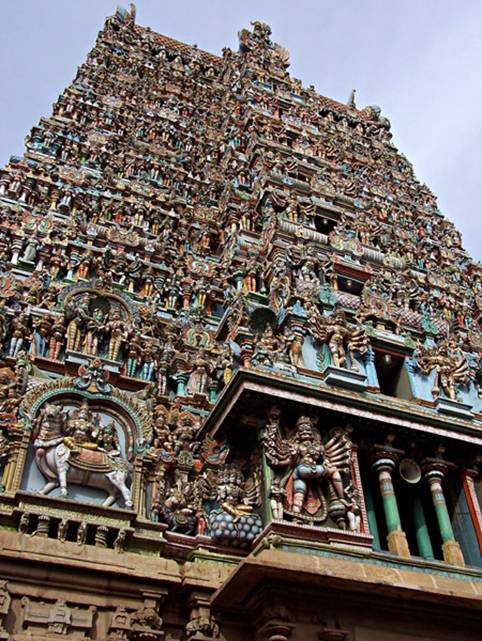
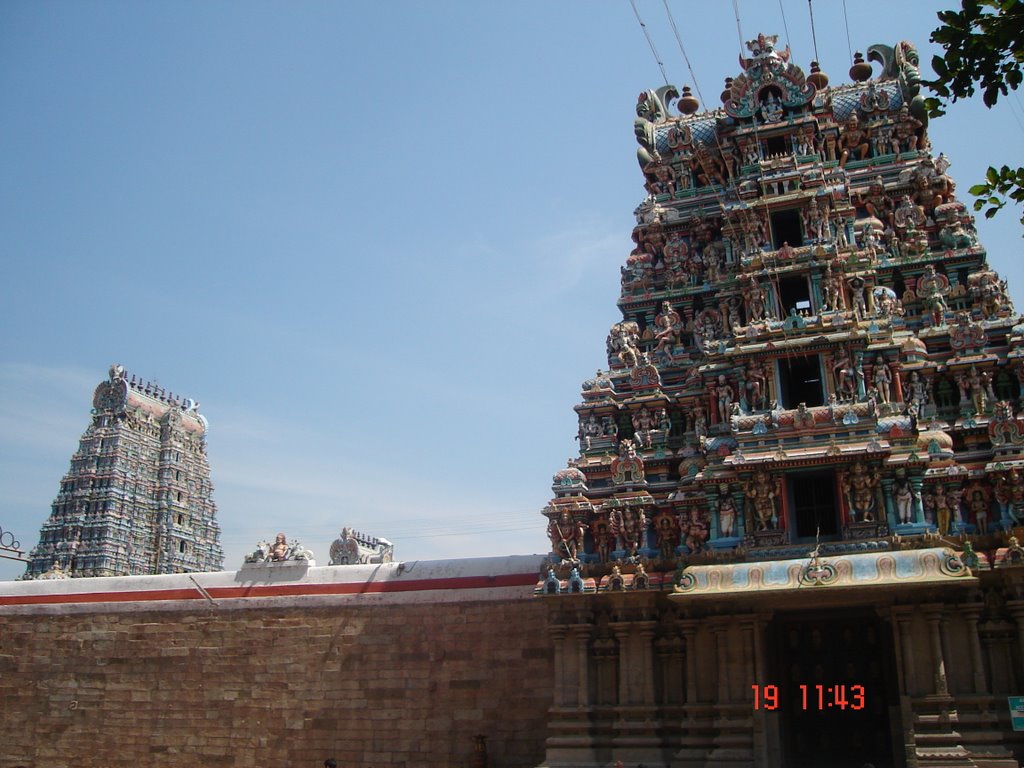
After quite sometime, posting the pics of the amazing temple at Madurai - The Meekashi Amman Temple. Exquisite, extra-ordinary grandeur, built by the early Tamilians. Enjoy!!!
Overview of the Meenakshi Amman Temple

Gopuram (Tower)


Another View of the Gopuram

Front view of the gopuram

Another view of two of the four gopurams

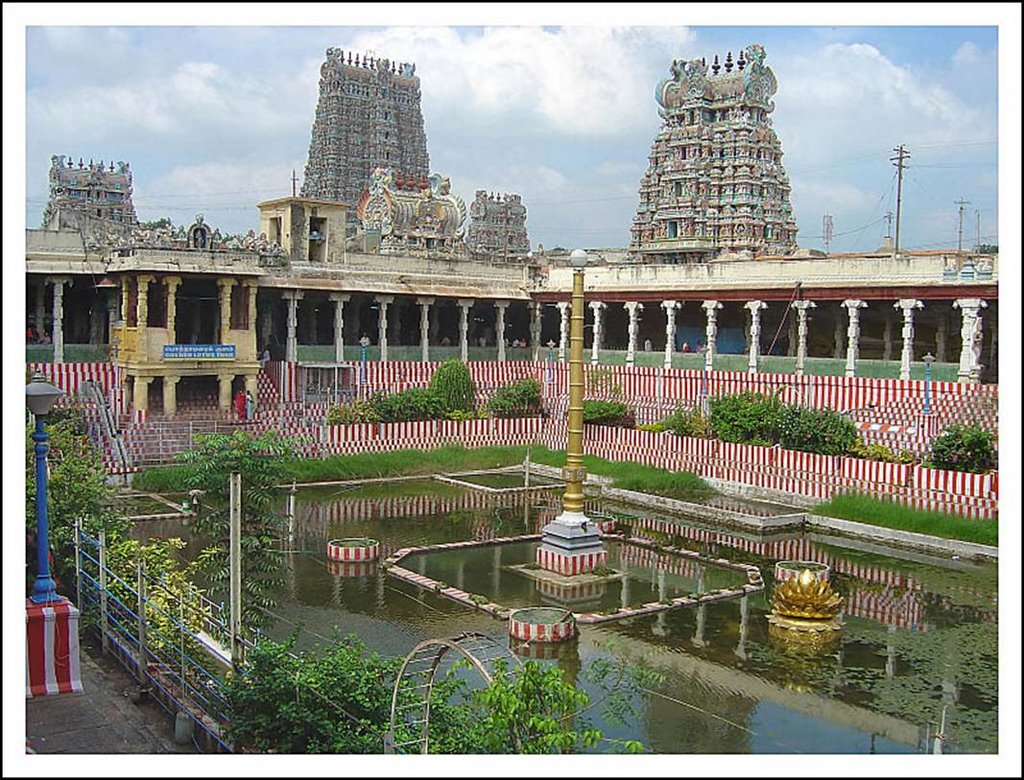
Inside the Temple, view of the Lotus Tank


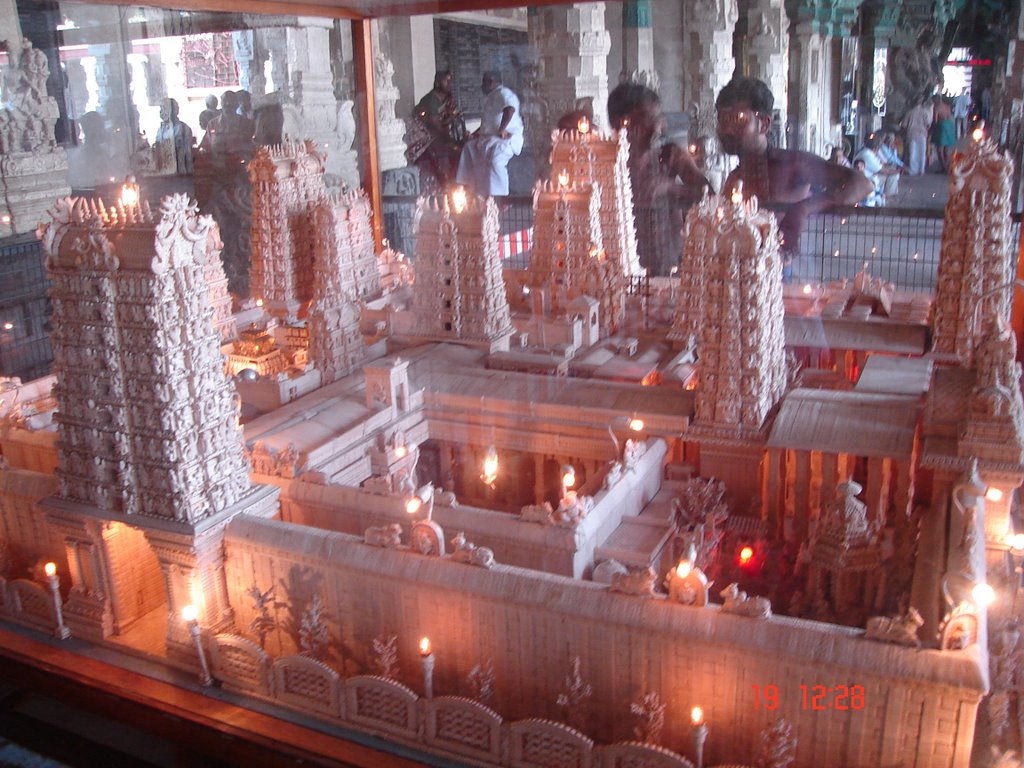
Meenakshi Amman Temple as a miniature model


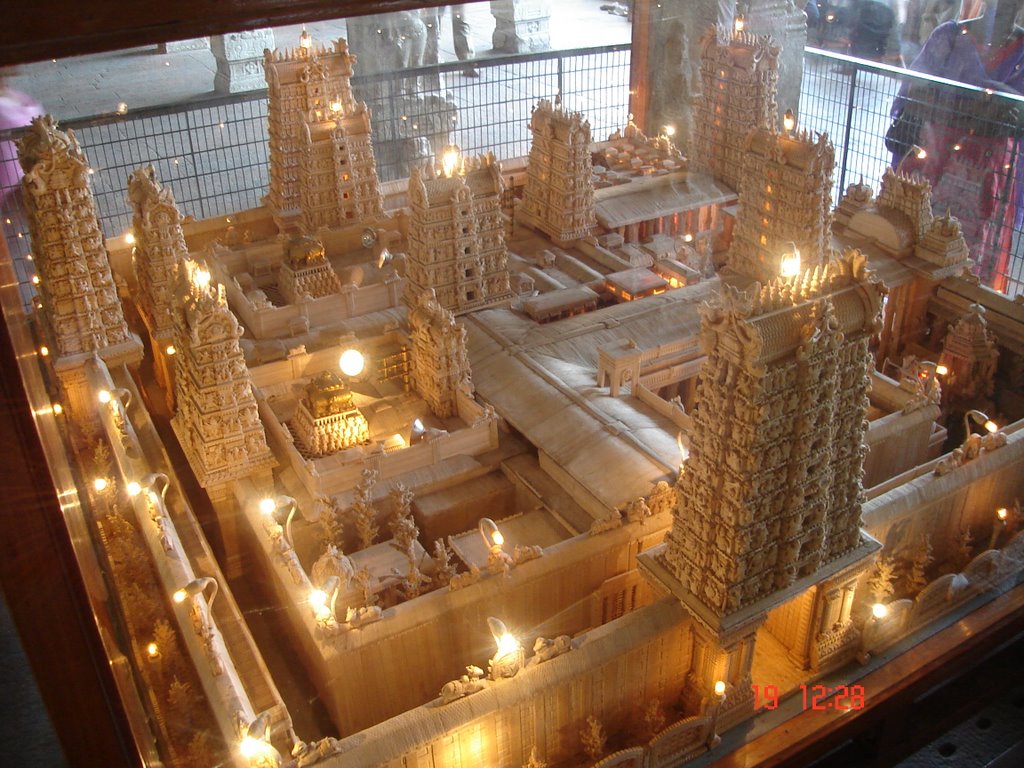
Another view of the Meenakshi Amman Temple as a miniature model


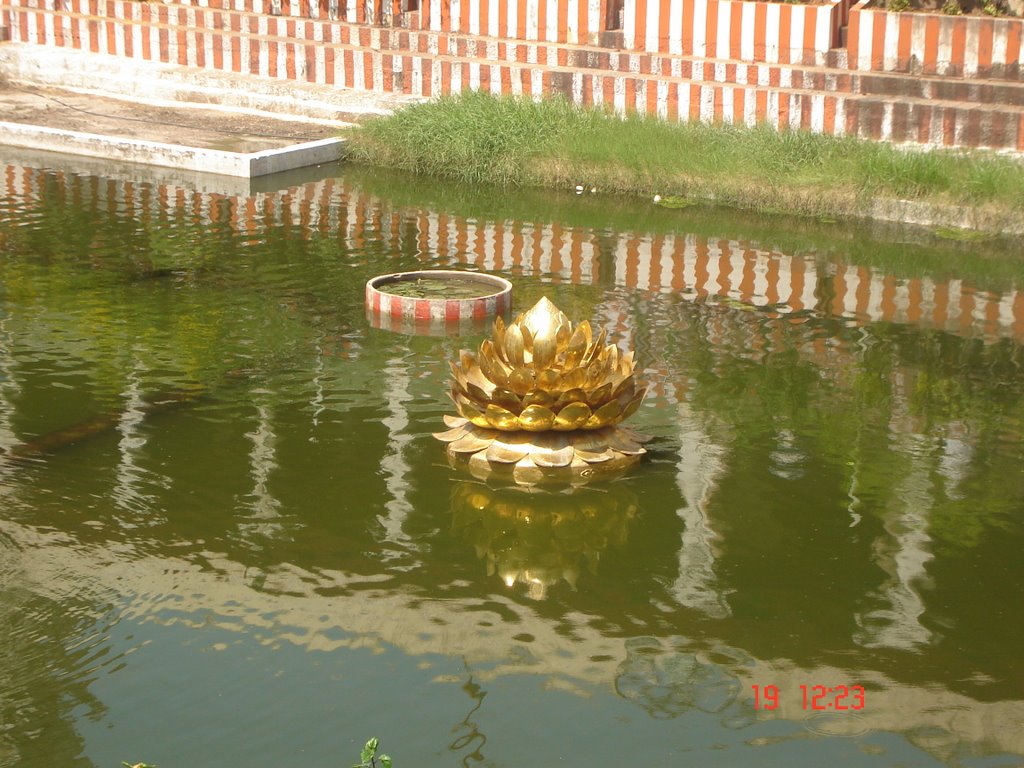
The Golden Lotus Tank (Porthaamarai Kulam)


Another view of the temple tower

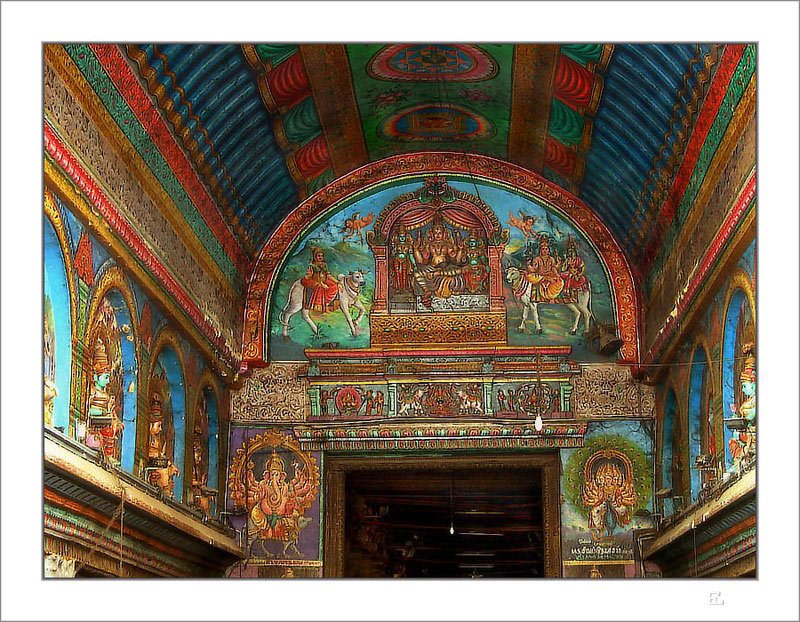
Inside the temple

Main Entrance to the temple

North Gopuram


The Golden Lotus Tank


Gopuram Vertical View


Madurai Meenakshi Amman Temple at night

Wednesday, January 25, 2006

The Tamilian Statement of the Pythagoras Theorem

Pythagoras Theorem, as every one would have studied in their high school mathematics, is defined as follows

"In any right triangle, the area of the square whose side is the hypotenuse (the side of the triangle opposite the right angle) is equal to the sum of the areas of the squares of the other two sides."

so the hypotenuse can be calculated as h = (a² + b²)½, that is square root of (a² + b²). But there is an amazing theorem in Tamil, rather a statement to find out the hypotenuse without the use of square-roots. This was stated, by Bodhayanar or Buddhayana, even before the time of Pythagoras. The statement goes like this

"Odum Neelam Thanai Ore Ettu
Kooru thaaki Koorilae Ondrai
Thalli Kundrathil Paadhiyai Saerthal

Varuvathu Karnam Thane"

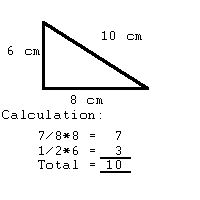
which means split the base (Neelam) into 8 equal parts (Kooru) and subtract 1 part from it and add half the height (Kundru) which gives the hypotenuse (Karnam). So lets work this out with an example. Consider a right triangle, of dimensions base 8 units and height 6 units so according to the pythagoras theorem the hypotenuse is square root of (64 + 36) which is 10. Now lets try the same with the above theorem

Divide the base into 8 equal parts so in this case each part is 1 unit

Subtract 1 part from the 8 parts so the remaining is 7 units ----- (1)

Add half the height which is 1/2 of 6 = 3 units -----(2)

Now adding (1) and (2) gives the total 10 units which is the hypotenuse of the triangle.
Amazing isn't it? Also if you notice there is no use of any square roots, but simple basic arithmetic addition, subtraction, multiplication and division. The only condition for this to work is that the base has to be greater than the height. So we can summarize the above as follows. If x, y are the base and height of a right triangle respectively then the hypotenuse

z = 7/8*x + 1/2*y where x > y

This works 100% accurately for all integral pythagorean triplets (i.e, the right triangles with dimensions that are round numbers like [3,4,5], [8,6,10], [5,12,13] etc) for the others it works with 95% to 99% accuracy

I don't have any rigorous mathematical proof to it, but it works!

More to come, until then...