Thursday, September 21, 2006

Great Temples In Desolate Ruins

Keezha Pazhayaarai, a temple near Kumbakonam, was once a great temple. Built in the 7th Century (around 660 A.D.). Worshipped daily by King RajaRaja Cholan - the Great Chola Emperor, history has ever seen. His son Rajendra Cholan was brought up by King RajaRaja Cholan's sister - Kundavai Naachiar - at this place. But the great temple is desolate ruins now, with the ruined Raja Gopuram (Front tower), act of time, plant growth on the walls that surround temple. King Kulothunga Cholan maintained and renovated parts of the temple and he built the 7-tier Raja Gopuram of which only one remains now. Take a look at the pictures of this great temple that has stood around 1500 years. The government started off the renovation in 1989 but stopped abruptly and has been ignorant till date. It is still not too late to save the temple. This is one of the temples that I visited recently. When we went there, only a old lady, Rukmani Ammal, took us around the temple. Tears almost came out our eyes when she told that she would like to see the Kumbabhishekam before in her life, which might not be probable. It really burdens our heart that the we don't have the thought that Rukmani Ammal has. There are more good hearted people who could help renovate this great temple. Hats off to the great lady!


The main entrace, Raja Gopuram, to the temple (only the first tier remains)


Closeup view of the first tier


Side view of the Raja Gopuram


View of the Raja Gopuram from inside the temple


Somakamalaambikai Amman Temple inside


The Great Temple (Mandapam and Vimanam)
In the photo - Yamanoor (taking picture), Pradeep,
Rukmani Ammal - The lady who took us around the temple, Vijayendran


The Temple Mandapam design in the shape of a chariot pulled by horses


View of the Temple Vimanam


Exit door from the temple shrouded with bushes and plants


The Mandapam - View from near the Vimanam


Could have been possibly a Mandapam or Corridor


Trees grown on the temple walls - a sign of slow destruction


Trees grown on the temple walls - a sign of slow destruction


Inside the first tier of the Raja Gopuram


Inside the first tier of the Raja Gopuram
(Vijayendran and Pradeep)


View of Temple's Inner gopuram from inside the first tier of the Raja Gopuram


View of Temple's Inner gopuram from inside the second tier of the Raja Gopuram


A headless Nandhi statue


A headless Nandhi statue


There another great temple that is almost in ruins now. The Veerabadhirar Temple at Darasuram, which is even older than the Airavatheshwarar Temple at Darasuram, which was built during the 12th Century. The Airavatheshwarar Temple at Darasuram is maintained by the Archaelogical Society of India however these two temples were ignored, reason unknown. The Veerabadhirar temple also has another speciality, that the famous poet Ottakoothar attained his Jeeva Samadhi (Grave) here.


The Raja Gopuram of The Veerabadhirar Temple - Darasuram


The Raja Gopuram of The Veerabadhirar Temple - Darasuram
(From inside the temple)


The Mandapam inside the Veerabadhirar Temple - Darasuram


These are the invaluable treasures our ancestors left for us and for the generations to come. Its our heritage, our pride and our possession that cross the borders of caste, creed and religion. We neeed to protect these heritage sites for our next generations. 


More to come, until then...

Friday, September 15, 2006

Connoisseur Kambar - Part 5

Borrowing money and other materials are very common these days. The interesting thing is that more banks are ready to give loans to people and are willing to put the people in debt. Apart from that people are more willing to buy an asset by getting a loan. Even I am not an exception though I write this post. In those days, borrowing was considered a sin and it was advised not to borrow anything. There is even an old saying


"Kadan Vaangi Kadan Koduthaar Kettaar"

meaning, those who borrow to pay another debt will ruin themselves.

Kadan - debt
Vaangi - get Koduthu - give;
Koduthaar - person giving something

Kettu - Spoil, ruin;
Kettaar - person spoiling themselves


Even Avaiyar, says that it is a great sin to borrow and to spend more than what one earns. Her song goes like this


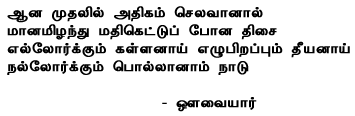
"Aana Mudhalil Adhigam Selavaanaal
Maanamizhandhu Madhikettu Pona Dhisai
Ellaarkkum Kallanaai Yezhupirappum Theeyanaai
Nallaarkkum Pollaanaam Naadu"
                  - Avaiyar

meaning, the one who spends more that what he earns, that is, he gets a loan to meet out his expenses. He will lose his dignity. He will lose his mind and will be considered by all as thief in whatever direction he goes. He will be a sinner in all his births and will be a bad guy for all the good ones .

Aana Mudhalil: Aana - Completed, Attained; Mudhalil - Capital, Earned money.
Adhigam: Too much, in excess
Selavu Aanaal - Expense met
Maanam Ezhandhu: Maanam - Dignity;
Ezhandhu - Lose
Madhi: Mind Sense; Kettu - Spoil, ruin
Pona - Going
Dhisai - Direction
Ellaarkkum - For all
Kallan - Thief
Yezhu pirappu - In all the births
Theeyan - Bad fellow
Nallaar - Good people
Pollaan - Bad fellow
Naadu - Compare, Understand

Kambar as usual in his exquisite style explains how it would feel to be in a debt.
Here goes his song.


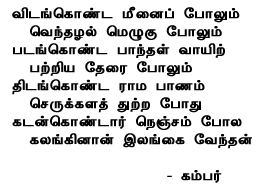
    "Vidam (Visham) Konda Meenaippolum
         Venthazhal Mezhugu Polum
    Padam Konda Paanthal Vaayil
         Pattriya Thaerai Polum
    Dhidamkonda Rama Baanam
         Serukkala thutra Podhu
    Kadankondaar Nenjam Pola
         Kalanginaan Elangai Vendhan"
                  - Kambar

meaning, Like a fish that has taken in poison; Like the wax near a hot flame; Like the toad that got caught between the venomous jaws of a snake; When the brave arrows of Lord Rama flew in the war field. Ravana's feared and panicked as of the victim's position in the above situations that can be compared to the person in a debt

Vidam (Visham) - Poison
Konda - having
Meen - Fish
Polum - Like
Venthazhal - Red hot flame
Mezhugu - Wax
Padam - Snake's hood
Paanthal - Snake
Vaai - Mouth, jaws
Pattriya - Catching
Thaerai - Toad
Dhidam - Brave, solid
Rama - Lord Rama
Baanam - Arrow
Serukkalam - War field
Uttra - Flew, Enter
Kadan- debt; Kondar - person in debt
Nenjam - heart, mind
Kalanginaan - feared, panicking
Elangai - Sri Lanka, Vendhan - King (Ravana)

So our forefathers avoided borrowing and being in a debt. As the debt would force a person to do anything that is considered mean. And he has to live his life always in fear. Kambar proved his eloquence and style by picturising the effects of being in a debt. The wonder nowadays is the banks promote credit cards and force people into debt which was considered a sin. Lets put a thought about it and try to contend ourselves with what we have and escape the great sin of debt. The point of not being in a debt might not be feasible for businesses today and even for people. But the facts elucidated by Kambar cannot be denied. Lets ponder over it.

More to come, until then...

Saturday, September 02, 2006

Connoisseur Kambar - Part 4

Many of us know Kambar from the perspective of a poet, but only a few know that he was also a person well-versed in the field of medicine. He used to treat many people during his time. There is even an interesting legend that illustrates his medical prowess too.

Before that lets digress into some Tamil tradition of medical practices. In those days and even now in most homes, there is a traditional practice that is followed for generations is that each family knows some medical treatments for simple ailments called "Paati Vaidhiyam" (Grandma's Medication). This does not mean that they won't go to the doctor for treatment, but they don't disturb the doctor for the ailments for which they know the medication. Not only did they know about the medication, but the people organised their day to day activities and food habits that led to a healthy and hygienic life. One such practice is that of taking "Oil Bath". Oil Bath is a type of bathing where the person is massaged either using gingelly oil (Nall Ennai) or castor oil (Vilakennai) - from head to feet. Then, after sometime that person takes bath using a powder that is a mixture of two powders named Arappu and Shikakai.

Taking oil bath has the following benefits

  1. the body is cooled and the heat is absorbed by the oil
  2. the blood circulation system is rejuvenated, blood flow increases and is regulated
  3. the dirt in the layers of the skin gets removed as the oil soaks the skin superficially and the dirt gets removed when bathed using the above mentioned powder, thereby preventing skin related diseases.

More details of such practices in the upcoming blogs. Let’s get back to Kambar's legend. One day a lady came rushing to Kambar, carrying her son and with fear, screaming that a snake has bit her son. She asked Kambar to treat her son and save him from death. Normally in those days for snake bite there was not antidote as the modern era, but the root of a plant named Nagathaali was used and it acted as an effective antidote. Kambar inspected the boy's condition; he noticed that the boy had gone pale and blue. He asked the boys mother about when the snake bit, she told that it was less than a Naazhigai (24 minutes) [A day consists of 60 Naazhigais]. Kambar thought that a snake bite could not have caused the boy to go that pale in a short span of time, and asked if the boy had taken an oil bath. The mother said yes. Kambar immediately said sorry to the boy's mother because the boy cannot be treated and saved because the oil bath has rejuvenated his blood circulation and the poison has spread very quickly that it is impossible to save the boy at that stage.

The above story is not to project any negative thing about oil bathing. But think it in the perspective of how effective it is in rejuvenating the blood stream. Kambar knew this aspect and was able to correctly assess the situation as a doctor. So Kambar was a multi-faceted person - a poet, a doctor and an advisor to the King. Let’s honour such a great man and we should be proud of having his as the crown of the Tamil Culture and stands as an exemplary. It is no wonder that Kambar and his works are an inspiration to many.

More to come, until then...

Sunday, August 06, 2006

Connoisseur Kambar - Part 3

Kambar not only wrote the great epic Ramayana, his works include the Saraswathi Andhadhi, Sadagopar Andhadhi and Yaer Yezhubadhu. Andhadhi is a form of poem in Tamil literature, in which the last word of verse forms the starting of the next verse. This one of the difficult and most toughest form in Tamil poetry which only a few poets have sung. Andhadhi itself is a sufficient proof for Kambar's eloquence and literary capacity. There is one more interesting incident in the life of Kambar which explains the presence of mind and the level of knowledge Kambar had.

There was practice that was followed by the Tamil Kings for generations. That is, if a poet sings any song in praise of the King or his country, the poet will be rewarded amply and will honoured for his poetic ability. Not only when praising of Kings did the poets were revered, but in general, all poets were revered and patronaged. Getting back to the story; during Kambar's time, there lived a man in the then Chola Kingdom wanted to sing a song in praise of the King and get the rewards. He had no prior experience in writing Tamil poetry. In spite of that his desire to get the rewards made him to write a poem. So he sat in the corridor of his house to write a poem. As he never wrote any poem before he did have a lead, so he was just watching the ambience to get a lead. He came up with the following poem by observing the ambience.


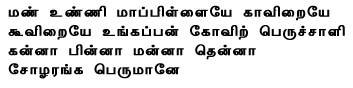
"Mann Unni Maappillayae Kaavirayae
Kooviryae Ungappan Kovil Peruchaali
Kanna Pinna Manna Thenna
Chola Ranga Perumaanae"

His song did not have any indepth meaning, he just scribbled whatever he saw. He never cared if what he wrote would be wrong. All that was in his mind was to get the reward. Small kids were playing a game called Mannunni Maappillai - meaning Sand eating, son-in-law - where one person would bend over and the others would jump over him by placing their hands in support. If the bending person does not stand steady he would pushed to the ground by the jumper and would be eating the sand. If the jumper does not jump correctly, he would fall and eat the sand. So this formed the lead for his song - Mann Unni Maappilayae.

Then a crow crowed, so he added - Kaavirayae. Then the cuckoo sang in its sweet voice - he added Koovirayae. And then a bandicoot (a large sized rat) ran from the inside the nearby temple onto the streets. On seeing that he wrote, Ungappan Kovil Peruchali.

He wanted to add something on his own as the third line so he added - Kanna, Pinna, Manna, Thenna. The phrase, "Kanna Pinna", is used as an interjection where it means disorder, scurrying or any such unclear work. Manna means Kings, Thenna means person from the South.

Then he saw the Srirangam Gopuram which was in the Chola Kingdom so he added the last line - Chola Ranga Perumanae. Ranga Peruman denotes Lord Ranganathar (Vishnu) at Srirangam. The word "Peruman" is used denote Gods, Kings and people of high rank. And there he completed his poem.

He then went to the King and sang this song. The King and his ministers got very angry on hearing this song because the song was insulting the King, by referring as the person eating Sand, shouting and crying unpleasantly and his father being a temple rodent. The King grew furios and ordered his men to imprison that man and give him a death punishment for insulting the King.

Our new poet got terrified and frightened and realised his mistake that writing a poem is not a simple thing. But Kambar who sat in the court was looking at this patiently and understood that the man just came out of the desire to get the reward from the King, but he does not have an intent to insult the King.

Kambar stopped the King and told that the song that the man sung has a great meaning though it might sound insulting in the first look. All the other poets and court staff were flummoxed by Kambar's statement. They all including the King demanded an explanation. Kambar started explaining

Mann Unni means Lord Krishna because he ate the sand and showed the entire Universe within his mouth. Maappilai means son-in-law. Lord Krishna married Andaal, the girl of the Chola kingdom, and therefore becoming the son-in-law of Chola Kingdom. So summing up Kambar said that the Chola Kingdom has Lord Krishna as the son-in-law and its a great thing to have the God as the son-in-law.

Kaavirayae - means Kaakkum Iraivan - Saving God. This refers to the King that he the saviour of the people and hence comparable to God.

Koovirayae - Koopita Kuralukku Varum Iraivan - The King attends peoples' requests as a God who answers the prayers of his devotees.

Ungappan Kovil Peruchaali: Ungappan = Un (Your) + Appan (Father), Ko - means God, King or Cow and in this context King, Peruchaali mean Perum (Big, Great) + Aali (Emperor, Ruler) - Summing up, your father is an emperor or great ruler among Kings.

Kanna means Lion, it also means Karnan who was very generous

Pinna - Descendant. Referring the King, heir of the Chola Throne.

Manna - King

Thenna - Man of the South. In this context, the King ruling the Southern region.

Chola Ranga Perumaanae - which can also be interpreted as Chola + Aranga (Kingdom, Stage) Perumane.

When Kambar gave this explanation, everyone was amazed including the King. They were really amazed at Kambar's knowledge, presence of mind, shrewdness and the ability to change a poem that was considered meaningless to a poem that has great indepth meaning. The King rewarded the man who wrote this poem in spite he knew that it was Kambar who saved him. Kambar met that man in person and in private and told him to learn the Tamil language properly and then start writing poems. And explained to him what would have happened in case he was not in the court. The man realised his mistake and promised Kambar that he would not write poems until he qualifies for the same.

This really, proves what Kambar was and why he is such a venerated and highly acclaimed poet (Kavi Chakravarthi) in Tamil Literature.

More to come, until then...


Friday, August 04, 2006

Connoisseur Kambar - Part 2

"Kamba Sutram" is phrase associated with Kambar that is used by the Tamil people in their day to day speech even today. "Kamba Sutram" means Kambar's formula. When we trace the roots of the phrase, it was actually, "Kamba Chithiram" meaning Kamban's Art. But due to the usage it got transformed over time as "Kamba Sutram". The phrase is used when referring to a context that is either difficult to do or even impossible. The phrase has an interesting legend behind it. Lets see what it is.

The then Chola King (Kulothunga Cholan), on hearing about the great epic Ramayana written by Valmiki, was interested in such a great epic being written in Tamil. So he engaged two contemporary poets - Kambar and Ottakoothar - to imbibe the crux and characterisation of what Ramayana is and produce such an epic in Tamil. The King also provided them with funds and facilities to have the epic written. Ottakoothar started off with the work and he put in efforts to produce the epic in Tamil and present it to the world before Kambar does. Kambar being a playful chap, whiled away the time spending all the funds he had, but the biggest gift he had in his life was the grace of Goddess Saraswathi - Goddess of Knowledge. Ottakoothar knew that Kambar did not do any work but he kept quiet and continued with his work. One fine day, the King called up the poets to see the each one's progress in getting the epic completed. Ottakoothar did his work and was ready to produce the work, but Kambar did not write even a bit, but he daringly appeared before the King praying and believing that his Goddess Saraswathi will never let him down.

The King asked both of them to explain as to what extent each one has progress and sing a sample from their work. Ottakoothar narrated the story. He said that "Ravana has kidnapped Seetha, and Lord Rama is on his way to recover Seetha and the Vaanarams (Ape army) are helping Rama in his mission. They are going to Srilanka but the sea that has to crossed is the obstacle. In order to overcome the obstacle, it was planned to build a bridge by throwing rocks in the sea". Ottakoothar finished saying that he has completed up to the point where the Vaanaram's are going to throw the rocks into the sea. And he sang a few lines from his work. He was applauded.

Kambar knew nothing about Ramayana until then, got the story line now. When it was his turn, the King asked Kambar's status. Kambar witty and smart enough, told that he has completed up to point where the Vaanarams are now throwing rocks into the sea and building the bridge. Note the point that Ottakoothar gave the lead that the Vaanarams are going to build the bridge but not yet started building and Kambar got that lead and used it cleverly saying that now the Vaanarams are building the bridge. The King asked to sing a few lines from his work. This is where the grace of Goddess Saraswathi that has been bestowed on Kambar is proved. He instantaneously sang the following


"Thumidham Theriththu Mael Logam Sella
Amirdham yena Devargal Vaai Pilandhanarae"

meaning, the drop that splashed when the rocks were thrown into the sea, rose up to the heavens and the Devar's (heavenly people (angels) including Indran etc) were awe struck with their mouths wide open, making them wonder if the water drop that splashed was Amirdham (the magical potion that keeps them young and rejuvenating). The interlingual rendition,

Thumidham - Water drop
Theriththu - Splash
Mael Logam - heavens
Sella - going
Amirdham - rejuvenating potion
Devar - Heavenly people
Vaai - Mouth
Pilandhanarae - Opening the mouth

Just see the presentation of Kambar, he actually bring the see in front of our eyes as if he drew an art out of words.

Well getting back to the legend, now the word Thumidham became the controversial word. Ottakoothar said that Kambar has used the word, Thumidham, that is outdated and out of use. But the fact is that the word is still used in a transformed form, called Thoodham (meaning water) - mostly used by Brahmins. If asked what the roots of the word Thoodham is, most say that it is Theertham which also means water but in a holy context. But actually Thoodham is the transformation of Thumidham.

Kambar argued that he can prove that the word is being used at that time. Ottakoothar asked for the proof and he took him to a village saying that he heard people using it there. But actually it was not. On the way he prayed within his mind to Goddess Saraswathi and pleaded her for help. And his prayers were answered. At one place, a woman was churning milk to take butter, and children were playing near the pot which she used to churn. The woman said


"Kulandhaigalae, thalli poi vilaiyaadungal, Thumidham therikka pogiradhu".


meaning, "Kids please go a little away from the pot and play, or else the drops (Thumidham), would splash on you"

And that was Kambar's proof. Actually the woman was Goddess Saraswathi incarnate. Ottakoothar understood that it was Goddess Saraswathi who was partial to Kambar got angry, threw his half completed work into the sea, which Kambar used and completed".

What history says is that Ottakoothar, accepted defeat before Kambar considering his work is nothing before Kambar's work and threw his work in fire, but Kambar was able to rescue two sections (called Gaandams) and added it to the four Gaandams he wrote. However the name Kamba Ramayanam stayed for the epic in Tamil

There is even another legend that says that Kambar playfully whiled away the time and when the King ordered that the epic should be completed by the next day. He prayed to Lord Ganesha who wrote so fast as Kambar sang the song and completed all the verses overnight.

Whatever be the legend, but the work that Kambar has produced transcends time and makes him immortal. Not only that the phrase "Kamba Chitiram" - Kambar's Art and "Kamba Sutram" - Kambar's Formula are both appropriate. And no other poet has presented such a work where the characters of the epic and the situations are brought live as an ART just by the words used. The FORMULA that Kambar used to an epic with lively ART has earned the rightful name "Kavi Chakravarthi" (Emperor of Poets).

More to come, until then...

Saturday, July 29, 2006

Connoisseur Kambar - Part 1

Kambar, the greatest poet of all times that Tamil Literature has seen, is a remarkable person and the only one to be crowned with the title Kavi Chakravarthi (Emperor of poets). Many people have written a lot about Kambar and his achievements, but we will see a few interesting bits in his life. His greatest work was Ramayana in Tamil called "Kamba Ramayanam" after his name and publishing such a great work earned him the name Kavi Chakravarthi. It is one of the best unparalleled literary work of all times. No one ever has created such a great work. His work consists of more than 10,500 verses depicting the story of Lord Rama. And hence the name Kavi Chakravarthi is crowned to him. He is the one and only Kavi Chakravarthi.

Kambar was born in a place called Therazhundhur, near the famous Thanjavur District. The place comes under reign of the Chola Kingdom. Kambar grew up and did his literary work in the Chola Kingdom but spent the rest of his life, after becoming the Kavi Chakravarthi, in a place called Naatarasan Kotai in the Pandya Kingdom. There is an interesting legend behind the switching of kingdom by Kambar.

Kambar published his great work at SriRangam Ranganathar Temple, a place near Thiruchirapalli (Trichy). The mandapam (corridor) where Kambar made the rendition still exists in the temple and is called the Kambar Mandapam. A few years later after being crowned the Kavi Chakravarthi, Kambar took pride and wanted to show his poetic talent at the Tamil Sangam at Madurai. So he went on his way to Madurai to meet the Pandya King and proclaim his achievement at the Madurai Tamil Sangam. He was in Naatarasan Kotai a place near Madurai and that is where the interesing event happened. Kambar wanted to know the way to Madurai in order to meet the King. So he saw a young boy herding cattle and asked him the way to Madurai. They boy asked Kambar, who he was and why he is going to Madurai. Kambar with pride told that he is Kavi Chakravarthi and he wants to meet the king to proclaim his achievement. The boy did not understand what is meant by Kavi Chakravarthi and asked Kambar what it meant? Kambar's pride grew no bounds told that it means the one who has learnt everything and he is one such person. This intrigued the boy and he asked Kambar if he could tell the letter (alphabet) that he writes on the sand; if Kambar was truly such a learned person. Kambar took it lightly, smiled at the chap and told to write the letter thinking what strange letter or unknown alphabet the boy could write in front of the great Kavi Chakravarthi. To his surprise, the boy drew a wavy line from top to bottom like that of a snake and asked Kambar what that letter was. Kambar got totally confused as there is not such alphabet and letter that he has seen in all the literature that he studied. He laughed at the boy telling that there is no such alphabet. The boy replied instantaneously


"Idhu thaan Ayya Vandi Maatin Neer Ezhuthu"


meaning, this is the letter that is drawn by the urine of an ox that pulls the cart. The observation is that when the ox urinates while pulling the cart and walking its way, the urine is in such a wavy formation. Kambar realised that it is a lesson to his lavish pride he had in himself. There he realised that the boy is not an ordinary boy and fell at his feet realising his mistake that no one could learn everything and sang a song. I dont remember the exact song, but it goes something like this


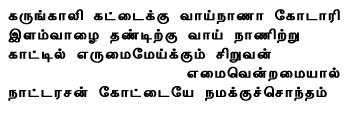
"Karungaali Kattaikku Vaai Naana Kodari
Elam Vaazhai Thandirkku Vaai Naanitru
Kaatil Erumai Meikkum Siruvan Yemai Vendramayal
Naatarasan Kotaiyae Namakku Sondham"

meaning, the axe that did not give up even for the hardest Karungaali (a tree) wood, gave up for a tender plantain (banana tree) stem. Here he compares himself as the axe that won all the great poets (Karungaali Trees) but fell for a boy (The plaintain stem). The boy, who herds cattle in the pastures, won me. So henceforth, my place is Naatarasan Kotai. And this is the story behind why Kambar switched kingdoms.

Legend says that the boy is either Lord Shiva/Lord Muruga incarnate. However, to keep up his promise, he spent the rest of his life at Naatarasan Kotai considering it as his native. Even today there is his tomb at Naatarasan Kotai. There is another interesting fact too. There is a big pond near his tomb. But that pond was not dug when Kambar was buried, but after his burial people would visit his tomb and take some of the sand from near his tomb. They mix a few pinches of the sand in the milk and give it to their children. People still believe that mixing the sand in milk and giving it to their children will make them knowledgeable persons as Kambar. As the famous quote says


"Kamban Veetu Kattu Thariyum Kavi Paadum"


meaning, "Even an inanimate loom in Kambar's home will pen a poem"


So people want their children to be knowledgeable and popular as Kambar. So they people in that region practise this. The people who came here have taken so much sand from near his tomb that over the centuries it has become a big pond.

The pitiable thing is that, nowadays, statues and tombs are being erected and maintained for people whose eternity in the Tamil world is questionable. But the tomb of the man, who has transcended the barriers of time and has an eternity in Tamil world, is in a dilapidated state. If possible, we should do something to make this honourable person known to the world and maintain his tomb in gratitude for the great work he has done

More to come, until then...

Sunday, July 02, 2006

Sagely Sivavaakiyar!

Sivavaakiyar, is a great poet who lived around the 10th Century AD and is considered one of the siddhars. Some legends say that he was the first of siddhars who lived in the ancient times. He got the name Sivavaakiyar because he uttered the word "Shiva" when he was born. His works are extraordinary masterpieces that could be done only by a person who has transcended the materialistic aspects of the world and attained the connection with the ethereal bliss. His views might sound atheistic but what he professes is beyond what normal minds can be inculcated. For this reason of atheistic tinge in his songs, his works does not have prominence in the Shaiva Literature, however many people have realised the correctness of what he says. He greatly opposed idol worship and the practices that were followed with to idol worship; basically seeking the Almighty in a stone or a statue, confining the omnipresent in a small stone and considering the stone as GOD, etc. One of his songs adorns my blog as a header. Lets see some of his songs, including the one in the header


"Nattakallai Dheivamendru Naalupushpam Saathiyae
Sutrivandhu MonaMonavendru Sollumandhiram Yaedhada
Nattakallum Pesumo Naadhan Ullirukayil
SuttaSatti Sattuvam Karichuvai Ariyumo"
-Sivavaakiyar


meaning, "You consider an erected stone as GOD and you adorn that stone with flowers, go around it chanting and muttering some mantras! how is that possible? Will that erected stone talk you when the the Almighty (Lord Shiva) is within you. Will the utensils used to cook the food realise that taste of its contents?".

Nattakallai - Natta (Erected, planted) + Kallai - possesive case of Kall (stone)
Dheivamendru - Dheivam (GOD) + Yendru - like, consider
Naalu - Four
Pushpam - flower
Saathiyae - Adorn
Sutrivandhu - Sutri (Going around, revolve, rotate) + Vandhu - Come
MonaMona - An interjection to denote murmuring and muttering
SolluMandhiram - Sollum (Utter, tell) + Mandhiram - Mantra
Pesumo - Interrogative of Pesum (Talk)
Naadhan - Lord Shiva (the Almighty)
Ullirukayil - Ull (Within, inside) + Irukayil (Staying, residing)
SuttaSatti - Sutta (Heated) + Satti (Pot, vessel)
Sattuvam - Spoon
Karichuvai - Kari (Vegetable cooked) + Chuvai (Taste)
Ariyumo - Interrogative of Ariyum (Knowing, being aware)

What he says is that the act of being in an oblivion without realising the supreme within oneself and searching elsewhere is like the utensils that do not realise the taste of food, that is within them, being cooked. Understand the Almighty within yourself. Now lets see the song in the header of this blog.

"Ninaipathondru Kandilaen Neeyaladhu Verilai
Ninapumaai Marappumai Nindra Maayai Maayaiyo
Anaithumai Agandamai Anaadhimun Anaadhiyaai
YenakkulNee UnakkulNaan Ninaikumaaru Yenganae"
-Sivavaakiyar


This song is rather song to GOD Almighty himself, his humility, simplicity and divine faith is at its zenith. Lets see the meaning, "I have never known anything other than YOU(GOD) to think. Is the illusion of my consciousness and oblivion actually an illusion or is it you? YOU (GOD) have been everything and nothingness, a being without beginning of all the beings without beginning. When will be the day when I could think that you are within me and I am within you?"

Ninaipathondru - Ninaipathu (Thinking, Imagining) + Ondru (Thing,One)
Kandilaen - Kandu (See, Imagine, Being Aware) + Ilaen - Negation
Neeyaladhu - Nee (You [GOD in this context]) + Aladhu - a variation if Illadhu indicating negation
Verilai - Veru (Other) + Illai - Negation
Ninapumaai - Ninaipu (Thought, Consciousness)
Marappumai - Marappu (Forgetting, Oblivion)
Nindra - Stand, Stay
Maayai - Illusion
Anaithumai - Everything
Agandamai - Nothing
Anaadhi - Thing without a beginning or origin
YenakkulNee - Yenakkul (Within me) + Nee
UnakkulNaan - Unakkul (Within you) + Naan (Me)
Ninaikumaaru - Thinking so
Yenganae - When, how

The next one for the common man rather atheists,


"IllaiIllai Illaiyendru Eyambukindra Yezhaikaal
Illaiyendru Nindrathondrai Illaiyennal Aagumo
Illaiyendrum UnduEndrum ErandumOndri Nindradhai
YellaiKandu Kondapaer Inipirapadhu Illayae"
- Sivavaakiyar


meaning, "You poor people claiming that GOD does not exist, GOD does not exist! Will it be true that a Being existing as non-existent (not able to see physically) to actually not exist? Those who realise the bounds of that Being that is existing as non-existent and existent will never be reborn to undergo the trials and tribulations of birth"

Illai - Negation, not existing
Eyambu - Claim, express
Yezhai - Poor
Nindra - Exist, Stand
Undu - Affirmative, Existing
ErandumOndri - Erandum (Both) + Ondri (Merge, Dependent)
Yellai - Bound, confines
Kandukonda - Found, obtain usually after searching
IniPirappadhu - Ini (Hereafter) + Pirappadhu (Being born)

Sivavaakiyar has transcended the boundaries of materialistic world as the above and other songs illustrate. He professes what the Brahmasutra (The origin of the Universe, The Composition of what is called Brahmam - not Brahma (The GOD of Creation)) says, "All of you and everything around you is Brahmam". In simple physics terms, all objects are manifestations of matter and so is all things in the entire Universe and the Universe itself is the manifestation of Brahmam. You have to realise the Brahmam with you first, don't try to give it a shape or visualise it as something or confine it to some object is what Sivavaakiyar says, a great sagely thought indeed. Lets try to think from his perspective and realise the Brahmam

More to come, until then...