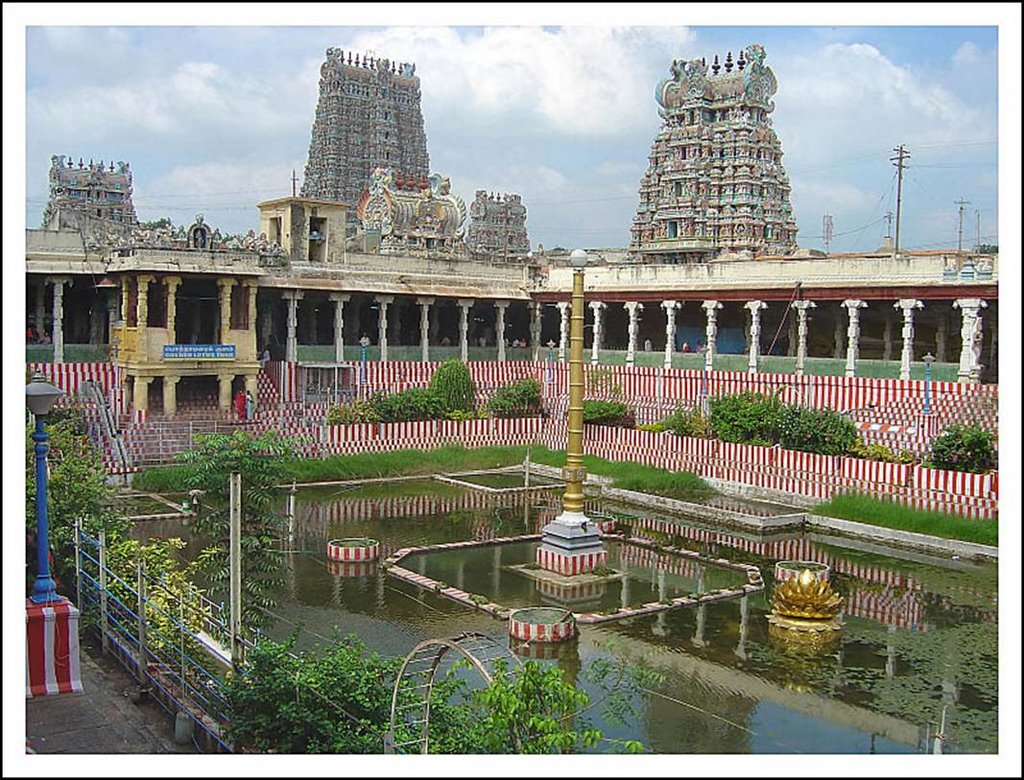
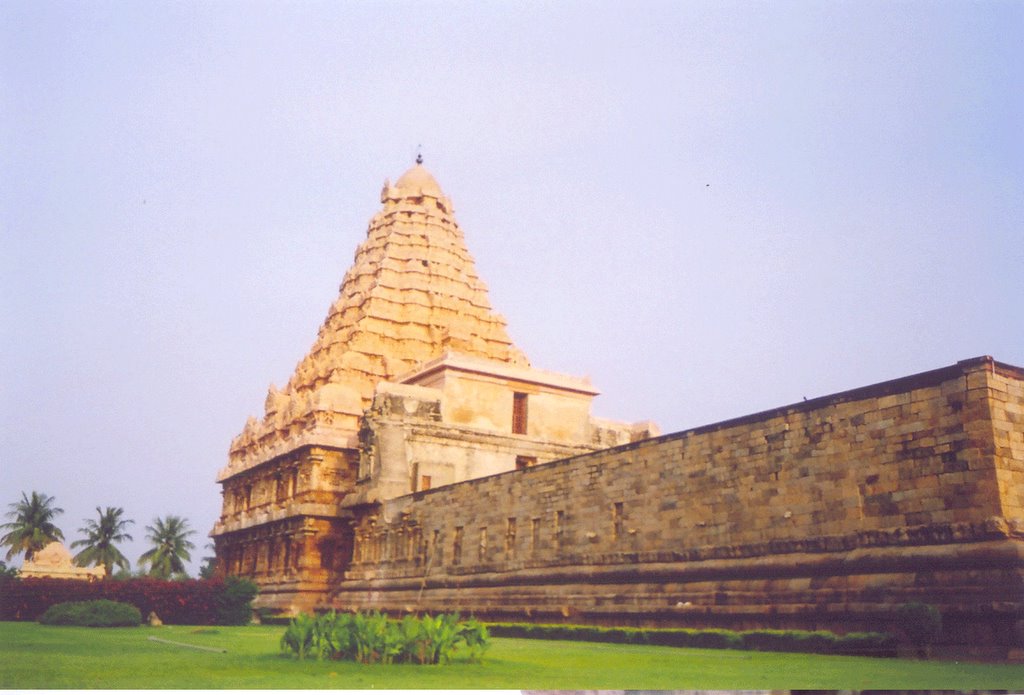
Sunday, April 30, 2006

King RajaRaja Cholan and his magnificent splendour

Some magnificent pictures of the great King and his work!!!


King RajaRaja Cholan
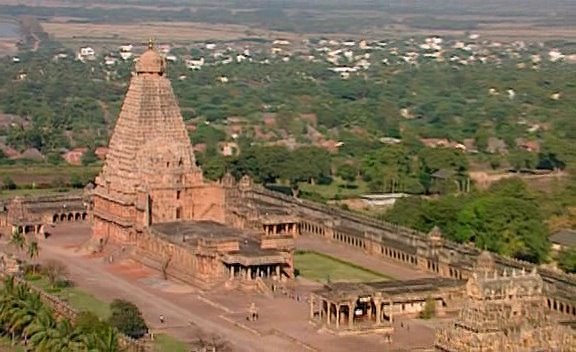

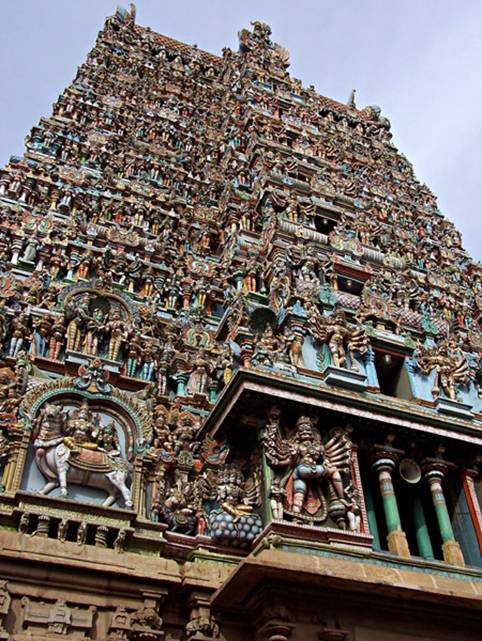
Spectacular view of King RajaRaja Cholan's magnificence
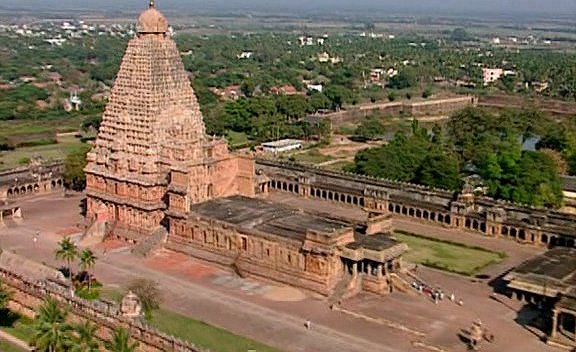

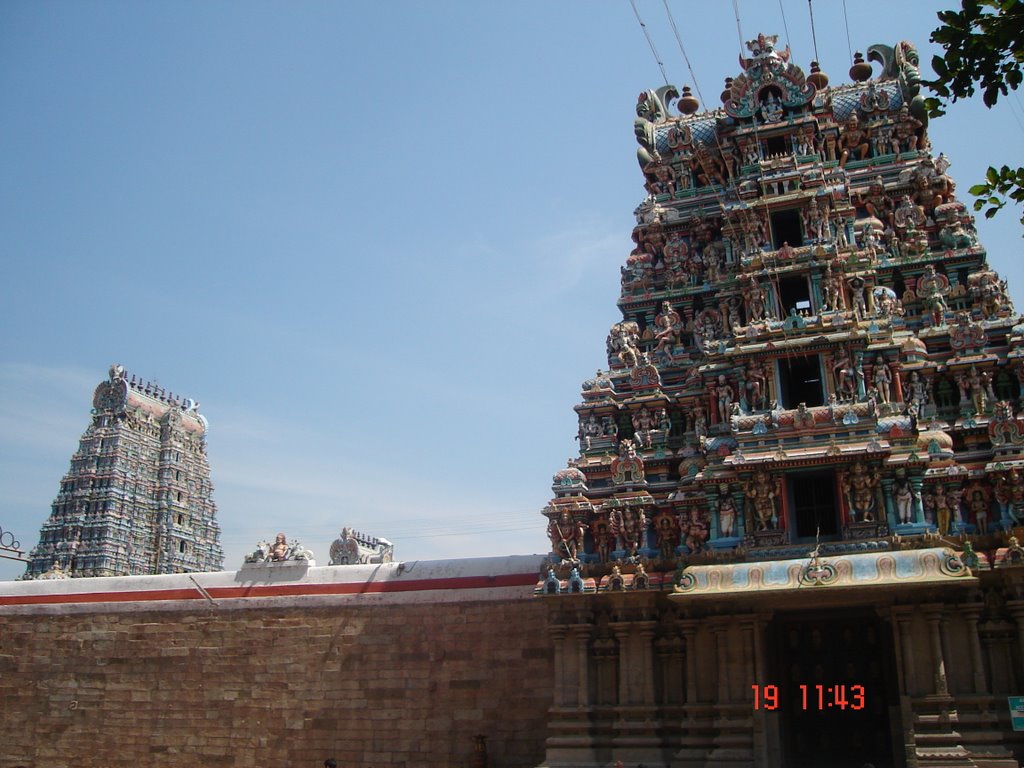
Another spectacular view of the temple
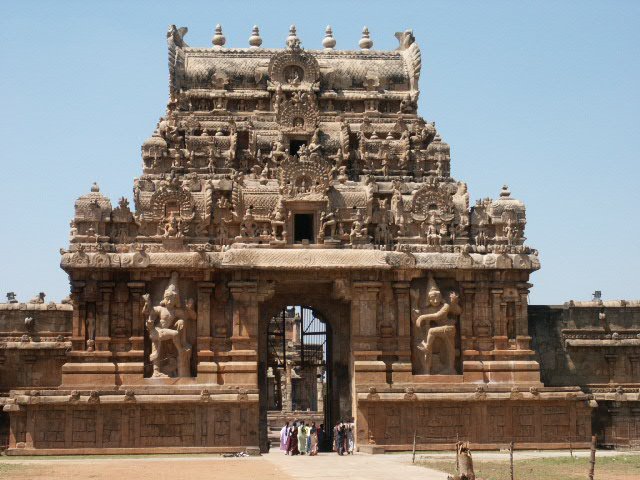

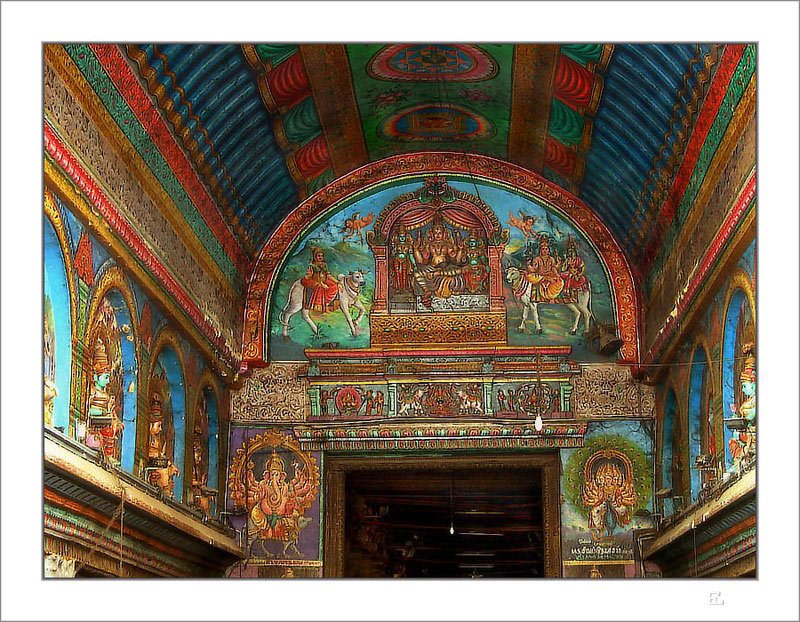
Entrance to the temple - The Gopuram

More to come, until then...

Tuesday, April 18, 2006

The Hidden Treasures in Tamil!!!

"To read between the lines" is a famous phrase used in English literature to infer something different from what is plainly indicated or to detect the real meaning as distinguished from the apparent meaning. Tamil has a wealth of such songs, information written by various poets saints etc., which I refer to as hidden treasures. These treasures have to be unearthed meticulously to get the great meaning inside them. Now lets jump into the treasure hunt. From this post onwards, I will try to post the text in Tamil too, to help the Tamil readers. The transliteration in English will continue as before. Well, now on to the first one,

"Kaanamal Konaamal Kandu Kodu
Aadu Kaana Pogudhu Paar Pogudhu Paar"
- Edaikaadar


On the first look, the meaning looks as if it means something with charity. We could derive plainly like this

Kaanamal - Without seeing
Konaamal - Without deviating, Without showing any grimace
Kandu - Seeing, Address
Kodu - Give
Aadu - Goat, Dance, Bathe
Kaana - On seeing
Pogudhu - Goes away
Paar - See

So clubbing it together, it might seem to be Without seeing the differences, Without deviating or showing grimace, address the needs of the poor and give them what you have and dance in merry then you will see your worries go away, go away

Nice try!!! However the actual meaning is not it. It is a song that relates to the way to worshipping the Sun at different times during the day. History tells that Sun has been worshipped as a God in many civilisations and being worshipped even to this day. Many slogams in Sanskrit especially the Aaditya Hridhayam is in praise of the Sun God. Well let's get back to the song, it means

"At dawn, the sun should be worshipped without seeing (Kaanamal), that is before He rises.
In the noon, without deviating (Konaamal), that is when He is right above your head.
And in the evening, seeing (Kandu), that is during sunset.
Then give (Kodu) your offerings.
Then Bathe (Aadu).
Then Realise and see the God in yourself (Kaana).
Then you can see your sins going way (Pogudhu Paar Pogudhu Paar)"

The next one might sound rather unacceptable in then normal case, but it is not actually, it conveys a greater meaning inside. Let's look at it now, it states three things that considered as purity or rather purest of the pure (Parisutham).


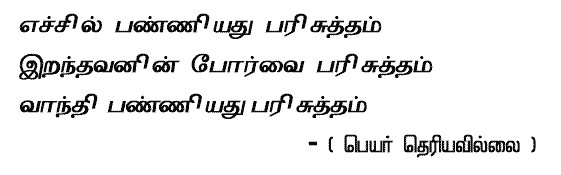
"Yechil Panniyadhu Parisutham
Erandhavanin Poravai Parisutham

Vaandhi Panniyadhu Parisutham"
- Anonymous


Paraphrasing the above song, would mean the following,

  • Yechil (Saliva) Panniyadhu (being done) - The substance that has been mouthed by someone is purest of the pure
  • Erandhanvan (Dead person) Porvai (Blanket) - The blanket covering a dead person is purest of the pure
  • Vaandhi (Vomit) - The substance that has been vomitted is purest of the pure.

Totally unacceptable ain't it? However digging the treasure in the song, would reveal that it refers to three things that are considered sacred even though they have the above mentioned characteristics. The things are Milk, Silk and Honey.

Milk is normally milked from the cow after the calf has drunk some milk, not sure if this is the practice nowadays, but still in most places in India this is the practice. So the calf has mouthed the milk. But the milk that is obtained after the calf has mouthed it is considered sacred and even used in Poojas and when worshipping the Gods.

Silk is the blanket of the dead silk worm in its pupae stage. Silk is obtained by boiling the cocoon in hotwater and the silk threads being separated later by some process. So the blanket, of the silk worm that dies within the cocoon, is considered sacred and used to adorn the God statues and used by people in auspicious occasions.

Honey, is the what the bee regurgitates after processing the nectar from flowers with some enzyme in its mouth. Honey has medicinal value and used for sacred, auspicious event and as an offering to the Gods.

Very interesting and valuable treasure isn't it? There are many such treasure to be found in the upcoming blogs.

More to come, until then...

Saturday, March 18, 2006

Interesting use of Pun in Tamil Literature

Pun, called Silaydai or Iratura Mozhidhal - in Tamil, is one of the interesting things that could be often found in Tamil Literature. One poet famous for composing songs and poems with pun is the famous Kaalamega Pulavar (refer to my previous blog on the Power of Aram). His style and elegance in the usage of pun is quite remarkable. He is even attributed with the name "Silaydai Pulavar". His songs contain the liberal use of pun. Let us see one example for it, the song goes like this

"Mukkaaluk Kesamun Munnaraiyil Veezhamun
Akkaalarai Kandu Anjamun Vikki
Irumamun Maakaanikku Yegamun Kachi
Orumaavin Keezharaiyin Rodhu"

At the first reading of this song, the meaning might reveal that he has used all the unit of measurements in Tamil - Mukkaal - three-quarters; Arai - Half; Kaalarai - one-eighth; Iruma - one-tenth; Maakaani - one-sixteenth; Oruma - one-twentieth; Keezharai - 1/640

But the actual meaning of the song is that, let me paraphrase it later -

"Before you need a third leg (your walking stick).
Before your hair grows white due to age.
Before you fear the Lord of death (The yama).
Before you hiccup and cough to your death at the end.
Before the great earth to give you a place.
Go and Worship the Lord Shiva in the name Kachiappar residing under a mango tree in the place called Keezharai"

Now, let me paraphrase the song. Mukkaal is a word formed by merging syllables of Moondru (Three) + Kaal (Leg). Yesa means begging, yearning, longing etc; so Mukkaalukku Yesamun - Before you yearn for three legs. Narai means whitening of hair due to old age. Mun - means front, before, Veezhamun mean before falling into, so Munnaraiyil Veezhamun - Before your hair falls into whitening phase due to old age. Kaalar - means The lord of death (Yama), kandu means found, see. Anja means fearing; so Ak-kaalarai kandu anjamun - Before you see/find Yama and fear. Vikki verb form of Vikkal - Hiccup, Iruma verb form of Irumal - Cough, so Vikki Irumamun - Before you hiccup and cough before death. Maakaani mean vast or big earth where kaani means earth, Yega means going onto, getting a place; So Maakaanikku Yegamun - Before you get a place for you on earth after death. Kachi Orumavin Keezharaiyin Rodhu - this requires quite an explanation Kachi means - Lord Shiva with the name Kachiappar, Oruma is a combination of Oru (One) + Ma (Mango Tree), Keezharai - a place in Tamil Nadu. Odhu means praise, enchant, worship. As a whole the combined meaning is as above.

It is quite amazing see such eloquence and adeptness of Kaalamega Pulavar. Many of his songs are like this, will post them in my later blogs. But he is not all, there are quite a few incidents that involve pun.

Once, when there was a gathering of all great poets during the Sangam age. On that occasion, the two famous poets, Avaiyar and Kambar met. During such events, normally there will be question/answer sessions, debates, and song compositions held. Being such an event, Kambar used that opportunity to denigrate Avaiyar, and asked a question

"Ore Kaaladi, Naalilai Pandhaladi"

Normally, Adi is used to address females in derogatory tone or among friends or elderly people calling women. So Kambar felt happy that he addressed the elderly poet Avaiyar, the then great female poet, as Adi though not directly. But what Kambar meant to ask as a question in the song was to identify a plant, called Aarai that has one foot but four leaves. The Vallarai (Indian Pennywort - Biological name Centella asiatica) a relative of the Aarai family that is now used as a natural memory power enhancer and rejuvenator.

Lets see the paraphrase below,

Ore Kaaladi -- Ore - One; Kaal - Foot; Adi - base, the lowest part, the surface beneath something. So it means - Thing having One Foot at the base.

Naalilai Pandhal Adi -- Naal - four; Ilai - Leaf, Pandhal - Tent having only the roof. So meaning, The four leaves forming a tent beneath.

So Avaiyar on hearing Kambar calling her derogatorily, fumed into fury and repeated with the similar pun answering his question

"Saetrilae Mulaithu Irukkum Aanaal
Kokku Nikka Udhavadhu Adhu
Yaman Yerum Vaaganamae Unnum
Nee Aaraiyada Sonnaai"

the first meaning, the plant that would grow in mud, but will not be helpful for the small storks to stand on it. Only the buffalos will eat that and you said the Aarai.

the second meaning, like the meanest of the species that grow in the mud, without helping anything to stand on it and only the slothful creature like the buffalo likes it. Having such qualities like the above, whom did you call derogatorily?

Also Ada, Dei means a derogatory tone or used among friends or by elders to address men

Aarai is also used as an interrogative pronoun - Who. And this formed an interesting incident, where Kambar got paid back through the same coin (The Pun) by Avaiyar.

Similarly there was another gathering of poets for a grand feast with the King, where one poet named Vemburaar (Person from the land of Neem) rushed in late to only find that he had no place in the feast. And the King remarked funnily at the poet with a pun.

"Vembukku Ingu Idam Illai"

first meaning, Vembu means Neem tree which is an indication of bitterness, has no place in this happy and august gathering.
And the other meaning, Vemburar does not have a seat in the feast as he arrived late.

Then the poet's eloquence and brilliance showed up, he went straight to the King's seat and just pushed the King a bit and sat in that place saying

"Vembu endrum Arasudanae Irukkum"

first meaning, Vemburar will always be beside the King.

And the other meaning Vembu - Neem, Arasu - Peepul tree. In Hindu tradition it is considered as auspicious and sacred to have the Peepul and Neem grow beside each other. Implicitly means that Vemburar being beside the King is sacred.

There are more such interesting events throughout Tamil Literature.

More to come. Until then...

Saturday, March 11, 2006

Amazing Madurai !!!

After quite sometime, posting the pics of the amazing temple at Madurai - The Meekashi Amman Temple. Exquisite, extra-ordinary grandeur, built by the early Tamilians. Enjoy!!!
Overview of the Meenakshi Amman Temple

Gopuram (Tower)


Another View of the Gopuram

Front view of the gopuram

Another view of two of the four gopurams

Inside the Temple, view of the Lotus Tank
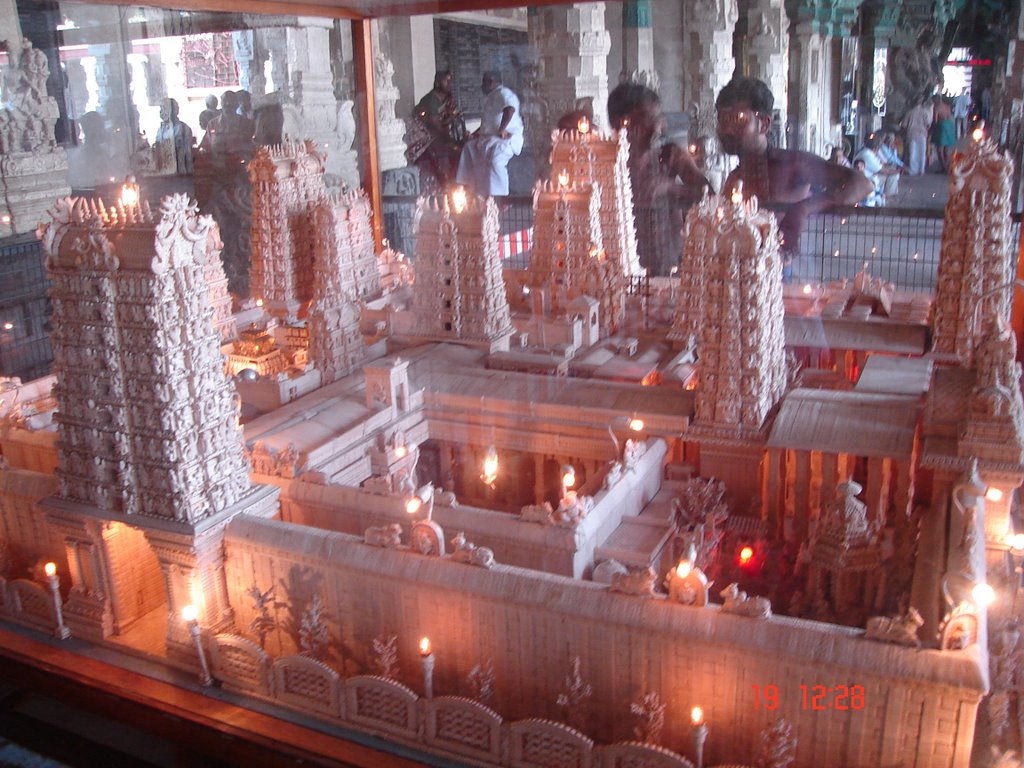


Meenakshi Amman Temple as a miniature model
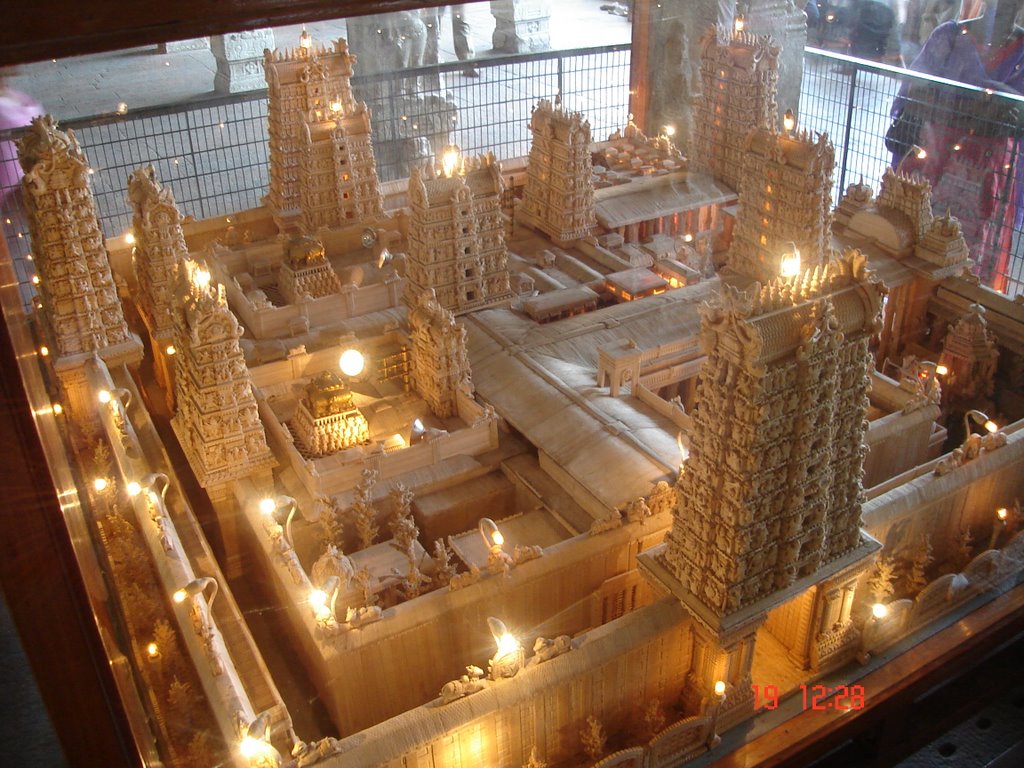

Another view of the Meenakshi Amman Temple as a miniature model
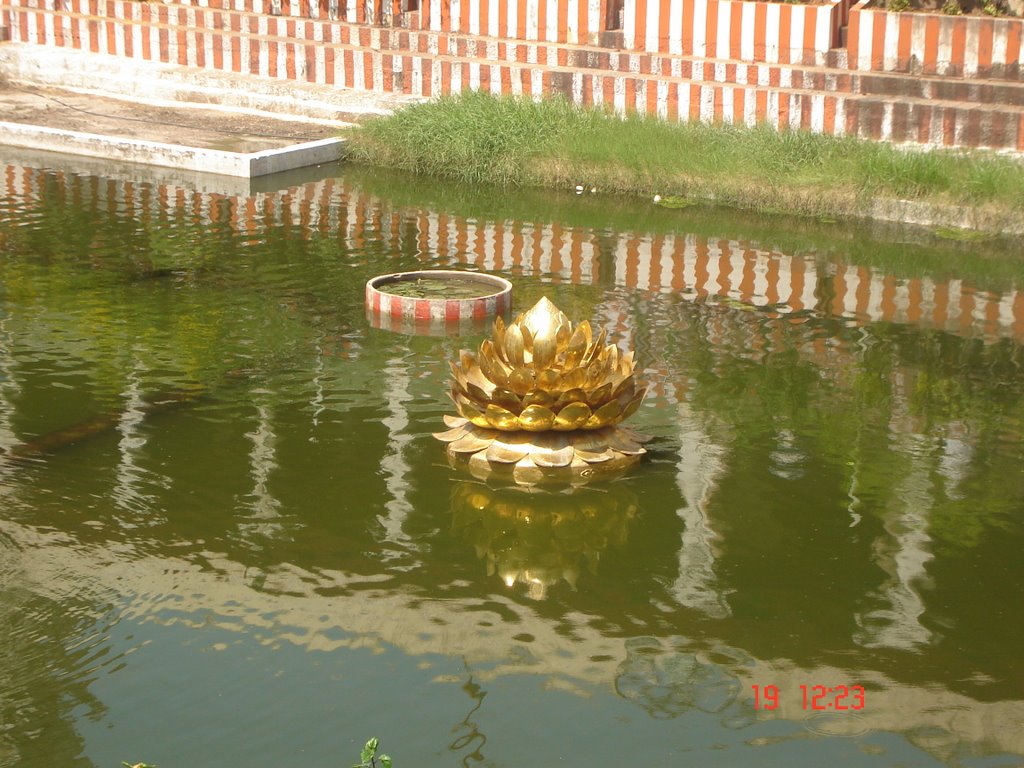

The Golden Lotus Tank (Porthaamarai Kulam)


Another view of the temple tower

Inside the temple

Main Entrance to the temple

North Gopuram


The Golden Lotus Tank


Gopuram Vertical View


Madurai Meenakshi Amman Temple at night
Wednesday, January 25, 2006

The Tamilian Statement of the Pythagoras Theorem

Pythagoras Theorem, as every one would have studied in their high school mathematics, is defined as follows

"In any right triangle, the area of the square whose side is the hypotenuse (the side of the triangle opposite the right angle) is equal to the sum of the areas of the squares of the other two sides."

so the hypotenuse can be calculated as h = (a² + b²)½, that is square root of (a² + b²). But there is an amazing theorem in Tamil, rather a statement to find out the hypotenuse without the use of square-roots. This was stated, by Bodhayanar or Buddhayana, even before the time of Pythagoras. The statement goes like this

"Odum Neelam Thanai Ore Ettu
Kooru thaaki Koorilae Ondrai
Thalli Kundrathil Paadhiyai Saerthal

Varuvathu Karnam Thane"

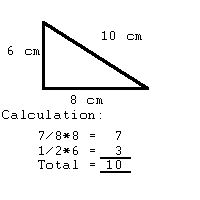
which means split the base (Neelam) into 8 equal parts (Kooru) and subtract 1 part from it and add half the height (Kundru) which gives the hypotenuse (Karnam). So lets work this out with an example. Consider a right triangle, of dimensions base 8 units and height 6 units so according to the pythagoras theorem the hypotenuse is square root of (64 + 36) which is 10. Now lets try the same with the above theorem

Divide the base into 8 equal parts so in this case each part is 1 unit

Subtract 1 part from the 8 parts so the remaining is 7 units ----- (1)

Add half the height which is 1/2 of 6 = 3 units -----(2)

Now adding (1) and (2) gives the total 10 units which is the hypotenuse of the triangle.
Amazing isn't it? Also if you notice there is no use of any square roots, but simple basic arithmetic addition, subtraction, multiplication and division. The only condition for this to work is that the base has to be greater than the height. So we can summarize the above as follows. If x, y are the base and height of a right triangle respectively then the hypotenuse
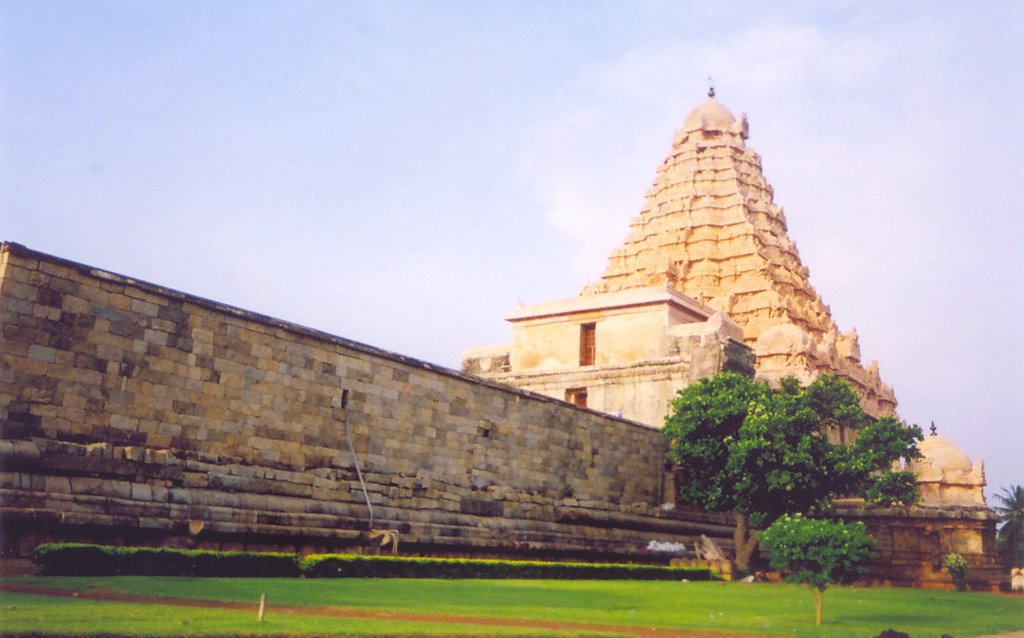
z = 7/8*x + 1/2*y where x > y

This works 100% accurately for all integral pythagorean triplets (i.e, the right triangles with dimensions that are round numbers like [3,4,5], [8,6,10], [5,12,13] etc) for the others it works with 95% to 99% accuracy

I don't have any rigorous mathematical proof to it, but it works!

More to come, until then...

Tuesday, January 10, 2006

The Power of Yoga

Yoga, the catch-phrase of today. For anything metaphysical, the first resort is to yoga. If you are stressed, mentally pressurized, wanting some peace of mind, the first suggestion that everybody would give is to practise yoga. What is yoga actually? Well, it is an organised way to keep your mind and physique in good shape and condition. Apart from that, practising yoga is said to be a cure for some diseases and a prevention from many. Well, as the old quote goes- Prevention is better than Cure. But in what ways!. Thirumoolar describes in his masterpiece, Thirumandhiram, many facets of yoga. In the following one he describes about what are the ailments that yoga cures when practised during different times of the day

"Anjanam Pondrudal Iyy-arrum Andhiyil
Vanjaga Vaadham Arum Madhiyaanathil
Senchiru Kaalaiyil Seydhidil Pitharum
Nanjara Sonnom Narai Thirai Naasame"

before explaining this song, let me digress a bit to tell something about the human body. Three main components drive the human body, called the Vaadham (Air), Piththam (Fire), Silaethumam or Saythumam (Water). The components in the appropriate proportions will have the body acting normally. If one of the them decreases or increases in proportion, it results in some ailment. Getting back to the song, Our body is like the anjanam (kajal), soft, in which, the ailments due to disproportionate Silaethumam can be cured by practising yoga in the evening, and of Vaadham(Air) during the afternoon and of Piththam (Heat/Fire) during the early dawn. And as a closing note of this verse, Thirumoolar says that what he has told is the truth and practising yoga will ensure that your hair colour will remain black making you look young and you would not have any eye related diseases.

"Pullinum Mikka Puraviyai Merkondal
Kall Unna Vendadhavanai KaliTharum
Thulli Nadapikkum Sombu Thavirpikkum
Ulladhu Sonnom Unarvudayorkkay"

This song refers to breathing techniques practised in yoga, it means those who adopt the practise of taking in air that is faster compared to a bird, then it gives the pleasure and briskness as you would drink the Kall (a drink prepared from the sap of toddy palm). The breathing practice will make you agile, will prevent fatigue. And Thirumoolar ends this with a quote, that "I have told to those who can realise"

"Thirigindra Vaayuvai Neripada Ullay
Nin malam aakidil Uruppu
Sivakkum Romam Karukkum Purappattu
Pogaan Puri Sadaiyonae"

meaning, "If channelised properly, within you, the air that goes around you, Your skins and organs will get rejuvenated, the hair will get darker and the Lord Shiva (Puri Sadaiyone) will always reside in your body"

More to come about Yoga, Thirumoolar and Thirumandhiram, until then...

Thursday, December 15, 2005

Architectural Wonders...

After quite some time, am back to blogging again. Just had a breather to post some pics. Will post other informative articles in the days to come


Gangai Konda Cholapuram
(built by King Rajendra Cholan son of King RajaRaja Cholan)

Another view of Gangai Konda Cholapuram


Built in the memory of the victory over a King of the North
The sanctum sanctorum - The Shiva lingam is said to be bigger in size than the one at the Brahadeeshwara Temple


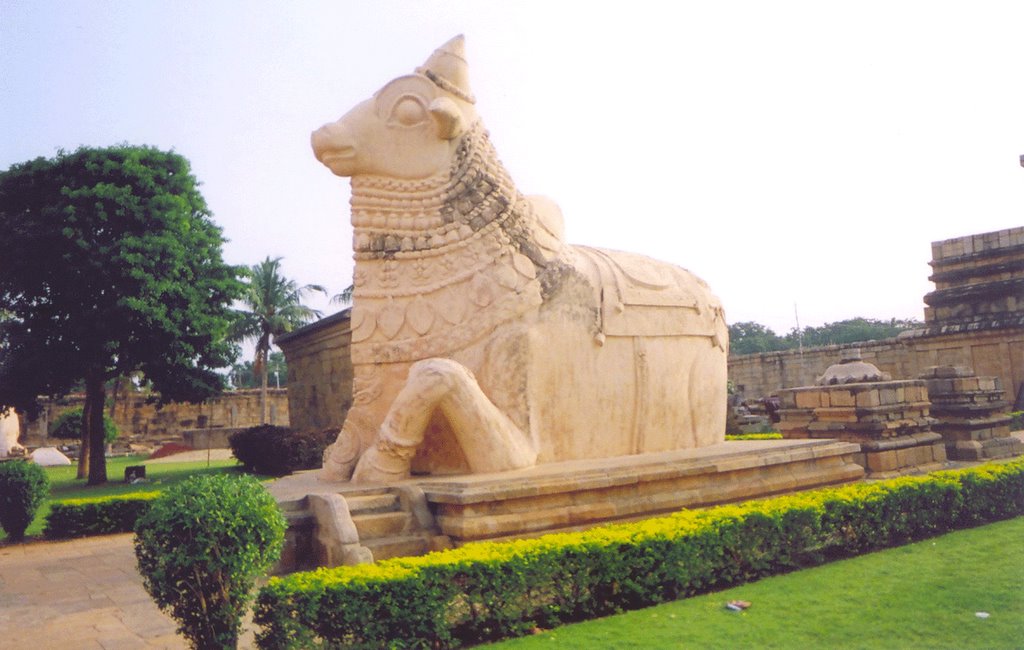
The huge Nandhi before the temple at Gangaikonda Cholapuram


The Singamuga (Lion Face) Well


The glorious temple at Darasuram built by a Chola King
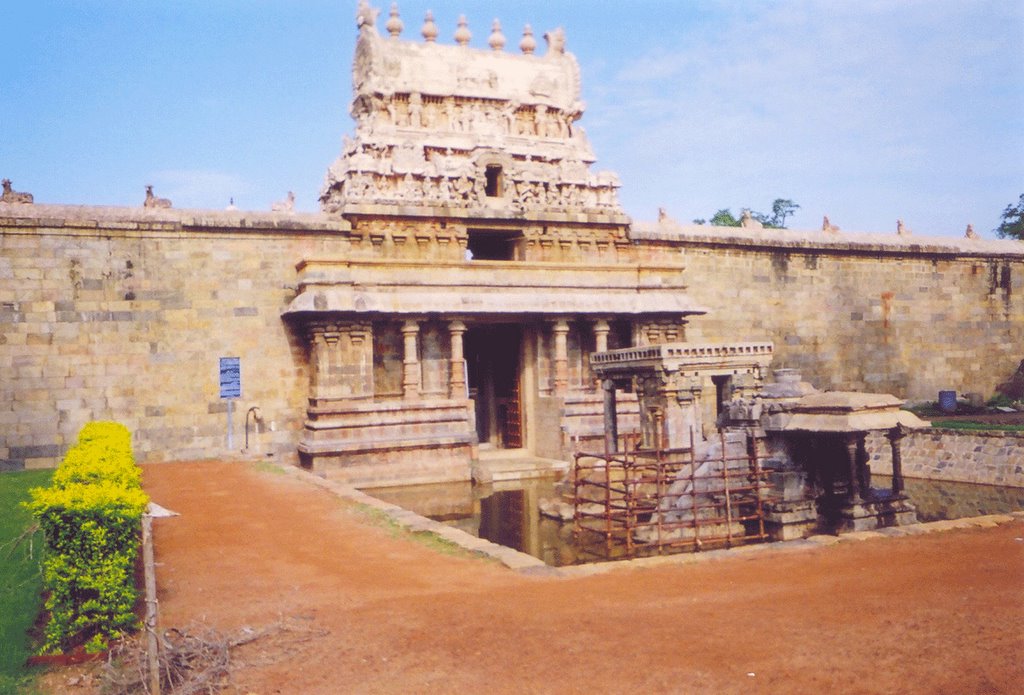

Entrance to the great Darasuram, the temple is built in such a way that anyone who wants to go into the temple has to wash their feet in the water pool before the temple


Architectural marvel inside the Darasuram temple (View 1)


Another view of the architectural marvel (View 2)


A Gestalt shift of a bull and an elephant at Darasuram


Brilliance in architecture at Thirubuvanam (again by another Chola King)
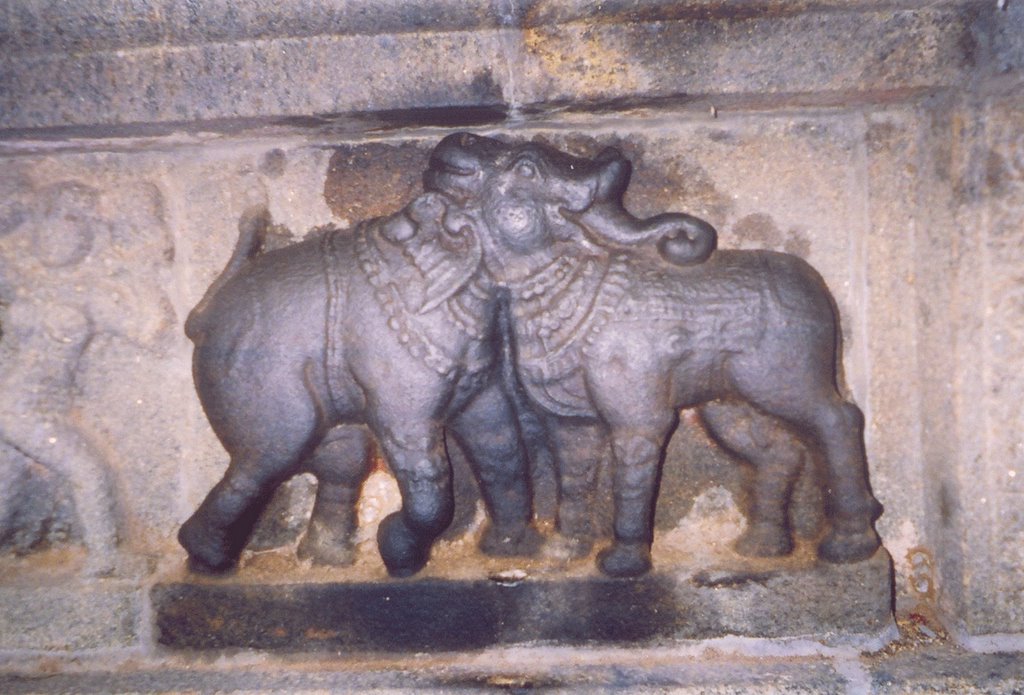

A Gestalt shift of a bull and an elephant at Thirubuvanam


More to come, until then...